

Sudden injuries from road traffic accidents can leave you facing uncertainty, tangled paperwork and constant calls from insurance companies. When every decision feels overwhelming, understanding your rights and the claim process becomes crucial for your recovery. Working with a solicitor on a no win no fee basis can unlock expert guidance, help you avoid costly mistakes and ensure you get the compensation you truly deserve.
Table of Contents
- What Solicitors Do in Accident Claims
- Types of Accident Claims Solicitors Handle
- How the Accident Claims Process Works
- Legal Duties and Responsibilities of Solicitors
- No-Win-No-Fee Arrangements and Costs
- Common Pitfalls and How Solicitors Help
Key Takeaways
| Point | Details |
|---|---|
| Role of Solicitors | Solicitors provide essential guidance in navigating the accident claims process, ensuring that victims receive fair representation and appropriate compensation. |
| Types of Claims | They specialise in various accident types, including road traffic accidents and workplace injuries, each requiring specific legal expertise. |
| Claims Process | The accident claims process is systematic, involving stages from initial consultation to potential court proceedings, each requiring thorough documentation. |
| Costs and Arrangements | No-win-no-fee agreements offer clients a financially accessible way to seek compensation, but clients must be aware of additional potential costs associated with their claims. |
What Solicitors Do in Accident Claims
Solicitors play a pivotal role in guiding accident victims through the complex legal landscape of compensation claims. Personal injury legal professionals provide expert navigation through the intricate processes of accident claims, ensuring injured parties receive fair representation and appropriate compensation.
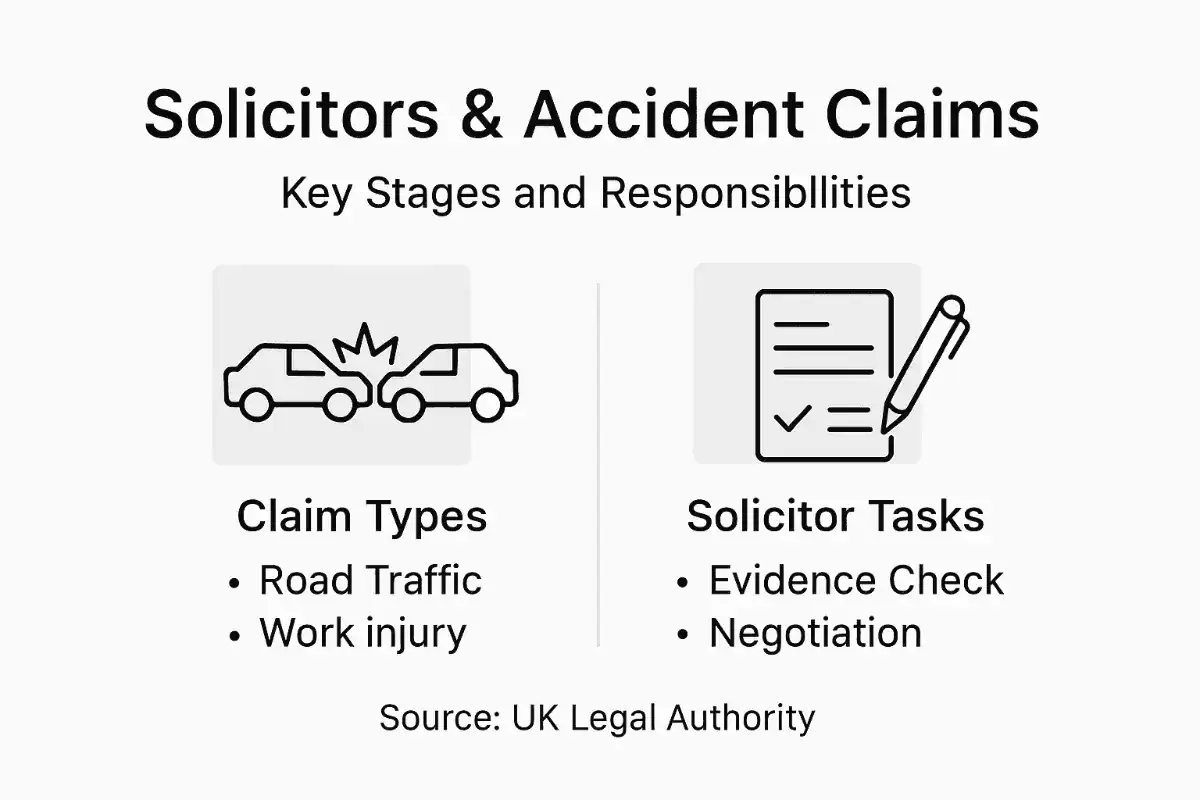
The primary responsibilities of solicitors in accident claims include several critical functions:
- Initial Case Assessment: Evaluating the legal merit and potential compensation for the claim
- Evidence Collection: Gathering medical records, police reports, witness statements, and expert testimonies
- Negotiation: Communicating with insurance companies and opposing legal representatives
- Legal Documentation: Preparing and filing all necessary legal paperwork accurately and promptly
- Court Representation: Presenting the case in legal proceedings if settlement cannot be reached
Through their comprehensive approach, solicitors transform a potentially overwhelming legal journey into a structured, manageable process. They understand the nuanced requirements of road traffic accident claims, leveraging their expertise to maximise potential compensation while minimising client stress.
Pro tip: Always request a detailed breakdown of potential legal costs and success rates during your initial solicitor consultation to ensure transparency and alignment of expectations.
Types of Accident Claims Solicitors Handle
Solicitors in the United Kingdom specialise in handling multiple categories of accident claims, addressing various scenarios where individuals suffer injuries or financial losses. Road traffic accident compensation claims represent one of the most prevalent types of legal proceedings that solicitors routinely manage, requiring comprehensive understanding of complex legal frameworks.
The primary types of accident claims that solicitors typically handle include:
- Road Traffic Accidents: Collisions involving cars, motorcycles, trucks, and pedestrians
- Workplace Accidents: Injuries sustained during employment across different industries
- Public Liability Claims: Accidents occurring in public spaces, shopping centres, or recreational areas
- Medical Negligence: Injuries resulting from substandard medical treatment
- Industrial Disease Claims: Occupational illnesses caused by workplace exposure
- Slip and Fall Incidents: Accidents occurring due to unsafe premises or environmental hazards
Each claim type demands specialised legal expertise and a nuanced approach to evidence gathering, negotiation, and potential litigation. Solicitors must carefully assess the specific circumstances, evaluate potential compensation, and develop a strategic approach tailored to the unique aspects of each case.

Here’s a quick comparison of major accident claim types and their unique challenges:
| Claim Type | Common Challenge | Typical Compensation Factor |
|---|---|---|
| Road Traffic Accidents | Disputed liability | Severity of injuries |
| Workplace Accidents | Employer negligence proof | Long-term loss of earnings |
| Public Liability Claims | Identifying responsible party | Quality of hazard evidence |
| Medical Negligence | Complex medical proof | Impact on quality of life |
| Industrial Disease Claims | Delayed diagnosis | Duration of exposure |
| Slip and Fall Incidents | Inconsistent witness accounts | Extent of documented injuries |
Pro tip: Collect and preserve all documentation related to your accident, including medical records, photographs, and witness contact information, as these can significantly strengthen your compensation claim.
How the Accident Claims Process Works
The accident claims process involves a systematic approach designed to help injured parties seek fair compensation. Personal injury claims solicitors play a crucial role in navigating the complex legal procedures that ensure victims receive appropriate financial support for their injuries and associated losses.
Typically, the accident claims process follows these key stages:
- Initial Consultation: Meeting with a solicitor to discuss the accident details
- Evidence Gathering: Collecting medical records, accident reports, and witness statements
- Liability Assessment: Determining legal responsibility for the accident
- Medical Evaluation: Obtaining professional medical assessments of injuries
- Negotiation Phase: Communicating with insurance companies or opposing legal representatives
- Settlement Negotiations: Pursuing fair compensation through strategic discussions
- Court Proceedings: Initiating legal action if settlement cannot be reached
Each stage requires meticulous attention to detail and comprehensive documentation. Solicitors work diligently to build a robust case, ensuring that all potential avenues for compensation are thoroughly explored and pursued.
Successful claims depend on the quality of evidence and the strategic approach taken by your legal representative.
Pro tip: Maintain a detailed personal file of all accident-related documents, including medical reports, correspondence, and expenses, to support your solicitor’s case effectively.
Legal Duties and Responsibilities of Solicitors
Solicitors handling accident claims bear significant legal and ethical responsibilities that extend far beyond basic legal representation. Personal injury claims solicitors are bound by stringent professional standards that mandate comprehensive client protection and diligent case management.
The core legal duties of solicitors in accident claims include:
- Professional Confidentiality: Maintaining absolute client information privacy
- Fiduciary Responsibility: Acting in the client’s best financial and legal interests
- Duty of Care: Providing competent and thorough legal representation
- Conflict of Interest Management: Avoiding scenarios that compromise client advocacy
- Transparent Communication: Providing clear, honest updates about claim progress
- Evidence Integrity: Collecting and preserving legally admissible evidence
- Ethical Negotiation: Pursuing fair compensation through legitimate legal channels
These responsibilities require solicitors to maintain the highest standards of professional conduct, balancing legal expertise with genuine client compassion. They must navigate complex legal frameworks while ensuring clients understand each stage of their compensation claim.
Solicitors are not merely legal representatives, but trusted advisors who guide clients through challenging legal landscapes with expertise and empathy.
Pro tip: Always request a detailed engagement letter that explicitly outlines your solicitor’s responsibilities, communication protocols, and fee structures to ensure complete transparency.
No-Win-No-Fee Arrangements and Costs
No-win-no-fee arrangements offer UK drivers a financially risk-free approach to pursuing accident compensation claims. No win no fee road accidents represent a critical legal mechanism that enables individuals to seek justice without upfront financial barriers.
Key features of no-win-no-fee arrangements include:
- Zero Upfront Costs: Clients pay nothing before case resolution
- Risk Mitigation: Financial protection if the claim is unsuccessful
- Performance-Based Compensation: Solicitors are paid only upon successful claim
- Conditional Fee Agreement: Legal fees contingent on case outcome
- Success Fee Limitations: Percentage-based fees capped by legal regulations
Under standard no-win-no-fee agreements, clients should understand potential additional expenses:
- Expert Witness Fees: Costs for medical or technical evaluations
- Court Disbursements: Potential administrative and filing expenses
- Medical Report Charges: Fees for comprehensive injury documentation
- Potential Opponent Costs: Risk of covering opposing legal expenses if claim fails
While no-win-no-fee arrangements provide financial accessibility, clients must carefully review all potential associated costs before proceeding.
Pro tip: Request a comprehensive written breakdown of potential fees and charges during your initial consultation to avoid unexpected financial complications.
The table below highlights key differences between standard fee structures and no-win-no-fee arrangements:
| Feature | Standard Fee Structure | No-Win-No-Fee Arrangement |
|---|---|---|
| Upfront Cost | Payment required at outset | No payment before outcome |
| Financial Risk | Client bears risk | Solicitor assumes risk |
| Success Fee | Fixed or hourly rate | Percentage of awarded compensation |
| Common for Injury Claims | Less frequent | Widely offered |
Common Pitfalls and How Solicitors Help
Navigating accident claims involves numerous potential challenges that can significantly impact compensation outcomes. Personal injury claim complexities require professional expertise to manage effectively and avoid critical mistakes that could compromise a claimant’s legal position.
Common pitfalls in accident claims include:
- Missed Deadlines: Failing to submit claims within statutory limitation periods
- Insufficient Evidence: Inadequate documentation of injuries and accident circumstances
- Incomplete Medical Records: Incomplete or poorly documented medical assessments
- Premature Settlement Acceptance: Agreeing to compensation before understanding full injury implications
- Lack of Professional Negotiation: Directly engaging with insurance companies without legal representation
Solicitors provide critical interventions to address these challenges:
- Strategic Evidence Collection: Systematically gathering comprehensive documentation
- Expert Medical Assessments: Coordinating thorough independent medical evaluations
- Negotiation Management: Protecting clients from unfair settlement offers
- Legal Deadline Tracking: Ensuring all procedural timelines are strictly observed
- Comprehensive Claim Valuation: Calculating full potential compensation accurately
Professional legal representation transforms complex claims from potential pitfalls into strategic opportunities for fair compensation.
Pro tip: Maintain a detailed personal accident log immediately after an incident, recording all relevant information to support your solicitor’s investigation.
Discover How Expert Solicitors Can Maximise Your Accident Claim Success
If you have suffered an injury due to no fault of your own, navigating the complexities of accident claims can feel overwhelming. This article highlights critical challenges such as evidence collection, negotiation with insurance companies, and understanding no-win-no-fee arrangements. At Mayiclaim, we understand these pain points and provide dedicated solicitors who specialise in personal injury claims across the United Kingdom. Our team ensures transparent communication, careful case management, and a thorough approach to every stage of your claim.

Do not let missed deadlines or inadequate evidence reduce your compensation. Take control of your situation today by contacting our experienced personal injury claims solicitors who guide you through every step of the no win no fee road accidents claim process. Get started now at Mayiclaim.co.uk and secure the compensation you deserve with expert help on your side.
Frequently Asked Questions
What responsibilities do solicitors have in accident claims?
Solicitors in accident claims are responsible for assessing cases, collecting evidence, negotiating with insurers, preparing legal documents, and representing clients in court if necessary.
How does the no-win-no-fee arrangement work for accident claims?
A no-win-no-fee arrangement means clients do not pay upfront legal fees. Solicitors are only paid when a case is successful, minimising financial risk for the claimant.
What types of accident claims can solicitors handle?
Solicitors can handle various accident claims including road traffic accidents, workplace injuries, public liability claims, medical negligence, industrial disease claims, and slip and fall incidents.
What are common pitfalls to avoid in the accident claims process?
Common pitfalls include missing deadlines for submissions, insufficient evidence collection, accepting premature settlements, and failing to maintain comprehensive medical records.
Recent Comments