

A sudden accident at work can leave you injured, uncertain, and facing unexpected challenges in your employment. For workers across the United Kingdom, understanding the definition of a workplace accident is the first step toward securing fair treatment and compensation. With the support of no-win-no-fee legal claims, you have a practical route to justice if your injury was not your fault. This guide clarifies key definitions and explains your options for pursuing compensation after a workplace incident.
Table of Contents
- Defining Accident At Work In The UK Context
- Types Of Workplace Accidents And Injuries
- Legal Duties Of Employers And Employees
- Reporting, Evidence, And Claim Process
- Common Mistakes And How To Avoid Them
- Understanding No-Win-No-Fee Compensation
Key Takeaways
| Point | Details |
|---|---|
| Understanding Workplace Accidents | Workplace accidents in the UK involve unexpected incidents during employment leading to injury, necessitating proper reporting and documentation for potential claims. |
| Legal Responsibilities | Both employers and employees have statutory obligations for workplace safety, including conducting risk assessments and following safety protocols. |
| Importance of Documentation | Timely and detailed documentation of accidents is crucial to strengthen compensation claims and safeguard legal rights. |
| No-Win-No-Fee Arrangements | These agreements allow employees to pursue workplace injury claims without upfront costs, making legal representation accessible regardless of financial means. |
Defining Accident at Work in the UK Context
Workplace accidents represent significant challenges for employees across the United Kingdom, with complex legal and regulatory implications. The Health and Safety Executive provides a precise definition that distinguishes workplace injuries from other types of incidents.
According to the Health and Safety Executive’s official injury statistics, a workplace accident encompasses any unexpected incident resulting in physical harm during employment activities. These incidents must meet specific reporting criteria to be officially classified and potentially qualify for compensation.
Key characteristics of a workplace accident in the UK include:
- Occurring during work hours or while performing job-related tasks
- Resulting in physical injury or potential health impairment
- Happening within the employer’s designated workplace or work environment
- Involving circumstances where employer negligence might be demonstrated
The legal framework surrounding workplace accidents recognises multiple scenarios, from minor incidents to severe injuries. Reporting mechanisms play a crucial role in documenting these events. Citizens Advice recommends that employees record all details comprehensively, including date, time, witnesses, and precise circumstances of the incident.
Types of workplace accidents frequently recognised include:
- Slip, trip, and fall incidents
- Equipment-related accidents
- Manual handling injuries
- Repetitive strain incidents
- Accidents involving workplace machinery
Pro tip: Always document workplace accidents immediately and seek medical attention, even for seemingly minor injuries.
Types of Workplace Accidents and Injuries
Workplace accidents represent a significant risk across various industries in the United Kingdom, with some sectors experiencing higher incident rates than others. Common workplace accidents demonstrate the diverse range of potential hazards employees might encounter during their professional activities.
The most prevalent types of workplace accidents in the UK can be categorised into several distinct groups:
- Slips, trips, and falls: Representing a substantial proportion of workplace incidents
- Manual handling injuries: Typically occurring during lifting, carrying, or moving heavy objects
- Struck by moving objects: Particularly common in manufacturing and construction environments
- Falls from height: Especially prevalent in industries involving scaffolding, roofing, or elevated work platforms
Each industry presents unique risks that contribute to the complexity of workplace safety. Construction and manufacturing sectors, for instance, experience higher rates of serious incidents compared to office-based environments. Mechanical equipment interactions and working at elevated heights pose particular challenges for worker safety.

To better understand workplace accident variations across UK industries, see the comparison below:
| Industry Sector | Typical Accident Risk | Example Hazards |
|---|---|---|
| Construction | High | Falls from height, equipment misuse |
| Manufacturing | Moderate to High | Machinery injuries, moving objects |
| Office | Low | Slips, trips, repetitive strain |
| Healthcare | Moderate | Manual handling, sharps injuries |
| Retail | Moderate | Slips, stock handling |
High-risk workplace accident scenarios typically involve:
- Inadequate personal protective equipment (PPE)
- Insufficient safety training
- Poorly maintained workplace infrastructure
- Complex machinery operations
- Lack of proper risk assessment protocols
Workplace accidents are not random occurrences but often result from systematic failures in safety management and risk mitigation.
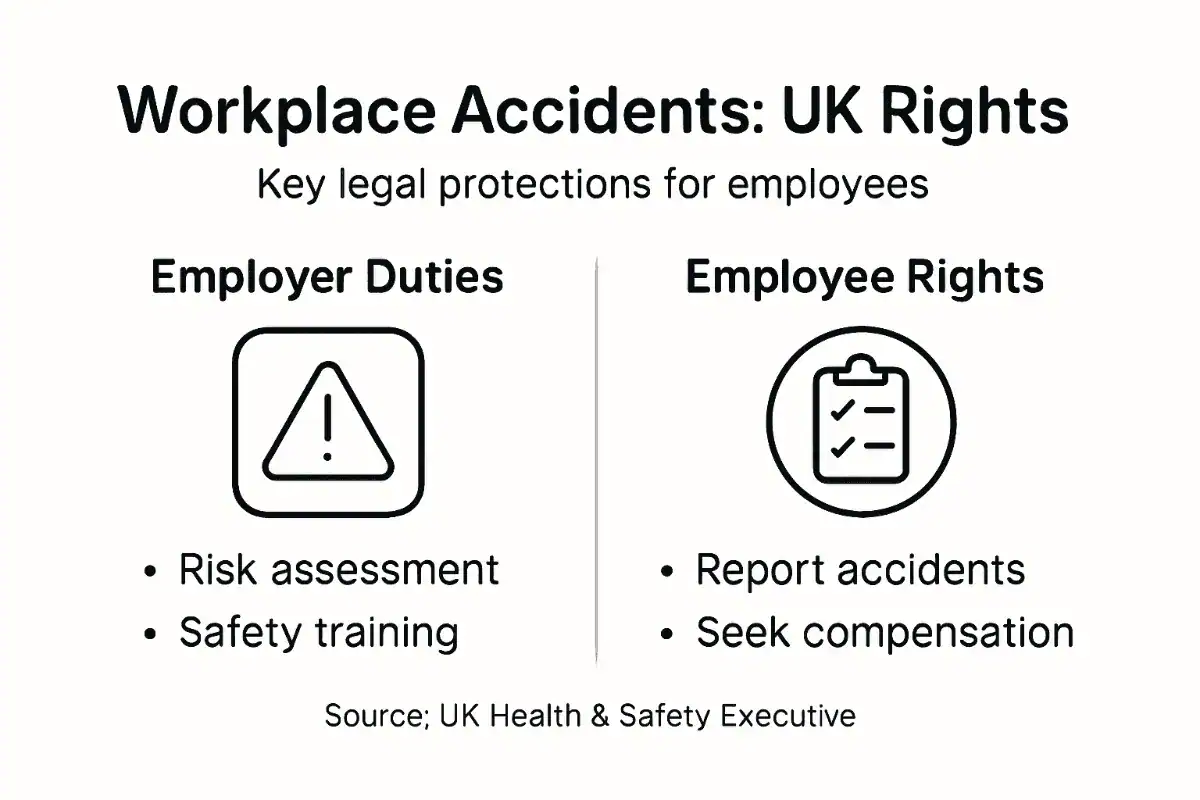
Employers have a legal responsibility to minimise workplace risks through comprehensive safety strategies, regular training, and proactive hazard identification. The Health and Safety Executive provides detailed guidance on preventing workplace accidents and protecting employee welfare.
Pro tip: Maintain a personal safety log documenting any workplace hazards or near-miss incidents to contribute to your organisation’s overall safety improvement.
Legal Duties of Employers and Employees
Workplace safety is a shared responsibility that requires both employers and employees to actively participate in maintaining a secure working environment. The legal framework in the United Kingdom establishes clear statutory obligations for both parties to prevent workplace accidents and protect individual welfare.
Employer legal responsibilities encompass several critical areas:
- Conducting comprehensive risk assessments for all workplace activities
- Providing appropriate personal protective equipment (PPE)
- Ensuring regular safety training and instruction
- Maintaining safe workplace infrastructure
- Implementing robust accident reporting and investigation procedures
Employees, simultaneously, bear significant responsibilities in maintaining workplace safety. Their legal duties include:
- Following established safety protocols
- Using provided protective equipment correctly
- Reporting potential hazards immediately
- Participating in safety training programmes
- Cooperating with workplace safety investigations
Legal obligations are not merely bureaucratic requirements but fundamental protections designed to preserve human life and wellbeing.
The Health and Safety at Work Act 1974 remains the cornerstone legislation defining these mutual responsibilities. This Act establishes a framework that places primary responsibility on employers while simultaneously requiring employees to take reasonable care for their own safety and that of their colleagues.
Key legal principles governing workplace safety include:
The following table highlights core legal duties and practical benefits for workplace safety stakeholders:
| Stakeholder | Key Legal Duty | Practical Benefit |
|---|---|---|
| Employer | Conduct risk assessments | Reduces accident frequency |
| Employee | Follow safety guidance | Improves personal safety |
| Manager | Oversee safety training | Promotes compliance and awareness |
| Health & Safety Rep | Monitor workplace risks | Ensures early hazard detection |
- Duty of care
- Reasonable practicability
- Proactive risk management
- Continuous safety improvement
Pro tip: Document every safety interaction and communication to create a comprehensive record of workplace safety efforts.
Reporting, Evidence, and Claim Process
Navigating the workplace accident claim process requires systematic documentation and strategic evidence gathering. Reporting workplace accidents involves multiple critical steps that can significantly impact potential compensation claims.
Key reporting requirements include:
- Immediately notifying your employer about the incident
- Requesting an entry in the official accident book
- Documenting precise details of the accident circumstances
- Collecting contact information from potential witnesses
- Seeking prompt medical evaluation and documentation
Evidence collection represents a crucial component of substantiating workplace injury claims. The most compelling evidence typically comprises:
- Comprehensive medical records
- Workplace accident book entries
- Photographic documentation of injury and accident location
- Witness statements
- Official incident reports
Timely and meticulous documentation can transform an uncertain claim into a robust legal case.
Under RIDDOR regulations, certain workplace incidents must be formally reported to the Health and Safety Executive, particularly those involving:
- Fatal accidents
- Major injuries
- Incidents causing over seven days of workplace absence
- Dangerous occurrences
Critical documentation strategies for successful claims include:
- Maintaining a comprehensive personal injury log
- Preserving all medical treatment records
- Recording detailed workplace communication
- Tracking potential financial losses
- Gathering physical evidence systematically
Pro tip: Create a dedicated folder to securely store all accident-related documentation, ensuring nothing critical is overlooked or misplaced.
Common Mistakes and How to Avoid Them
Workplace accident claims can be derailed by seemingly minor errors that compromise legal and compensation prospects. Common workplace accident mistakes often stem from lack of immediate action and inadequate documentation.
Critical errors employees frequently make include:
- Delaying incident reporting
- Failing to seek immediate medical attention
- Not collecting witness contact information
- Neglecting to document accident details
- Discussing case specifics on social media
- Accepting initial employer settlements without legal consultation
The most significant risks associated with these mistakes can substantially impact potential compensation claims:
- Loss of critical evidence
- Statute of limitations expiration
- Weakened legal positioning
- Reduced compensation potential
- Compromised future employment prospects
Proactive documentation and swift action are your most powerful tools in workplace accident claims.
Strategic prevention approaches recommended by safety experts include:
- Maintaining detailed personal incident logs
- Understanding your legal rights comprehensively
- Preserving all potential evidence immediately
- Seeking independent medical evaluations
- Consulting legal professionals early
Workplace safety protocols emphasise the importance of systematic reporting and comprehensive documentation to protect workers’ interests.
Pro tip: Create a digital and physical backup of all accident-related documentation to ensure no critical evidence is ever accidentally lost or destroyed.
Understanding No-Win-No-Fee Compensation
No-Win-No-Fee arrangements represent a critical legal mechanism enabling workers to pursue workplace injury claims without upfront financial risk. These agreements fundamentally transform access to legal representation by removing traditional financial barriers that might prevent legitimate claims from being pursued.
Key characteristics of No-Win-No-Fee agreements include:
- Zero upfront legal costs for the claimant
- Payment contingent on successful claim resolution
- Lawyer assumes financial risk of litigation
- Transparent fee structures
- Protection against potential legal expenses
- Professional assessment of claim viability
The financial mechanics of these agreements operate through several critical components:
- Initial free case evaluation
- Risk assessment by legal professionals
- Percentage-based success fee
- Potential recovery of legal costs from opposing party
- Comprehensive claim investigation
No-Win-No-Fee arrangements democratise legal access by eliminating financial barriers to justice.
Potential compensation elements typically encompass:
- Medical treatment expenses
- Lost wages and future earning potential
- Rehabilitation costs
- Psychological trauma compensation
- Equipment or adaptations required
Legal professionals carefully evaluate claim potential, ensuring only robust cases are pursued. This approach protects both the claimant and the legal representative from pursuing unwinnable litigation.
Pro tip: Always request a comprehensive written breakdown of potential fees and success probability before proceeding with any No-Win-No-Fee agreement.
Take Control of Your Workplace Accident Rights Today
Workplace accidents in the United Kingdom present many challenges, especially when navigating complex legal duties and compensation claims. If you or a loved one has suffered from an injury at work it is vital to understand your rights and the importance of thorough documentation and prompt reporting. Key pain points such as employer negligence, inadequate safety measures and unclear reporting procedures can make pursuing a claim overwhelming without expert guidance. Mayiclaim.co.uk specialises in providing support on a no-win-no-fee basis, ensuring injured workers receive the legal representation they deserve without upfront costs.

Do not face the difficulties of a workplace accident alone. Visit Mayiclaim to access expert advice on how to protect your rights and follow the proper claim process. Learn more about your legal entitlements and get started now before critical deadlines pass by exploring Accident at Work Claims support. Take advantage of professional help tailored to those impacted by workplace injuries and secure the compensation you deserve. Act decisively today to safeguard your future.
Frequently Asked Questions
What defines an accident at work?
A workplace accident is any unexpected incident resulting in physical harm during work-related activities, occurring during work hours or in the employer’s designated environment.
What are my rights if I experience a workplace accident?
Employees have the right to report the incident, seek medical attention, and pursue compensation for any injuries sustained due to employer negligence or unsafe working conditions.
How should I document an accident at work?
Document details of the incident comprehensively, including date, time, witnesses, and the circumstances surrounding the accident, and ensure you notify your employer and request an entry in the accident book.
What is a No-Win-No-Fee compensation agreement?
A No-Win-No-Fee arrangement allows workers to pursue claims for workplace injuries without upfront legal costs, with payment contingent on successfully winning the case.
Recent Comments