

Workplace injuries can disrupt your health, finances, and peace of mind. For British employees, the road to compensation involves more than just reporting the incident; it demands thorough documentation and clear action at every step. Whether you need help covering medical expenses or lost wages, understanding the process empowers you to build a strong claim. This guide highlights the vital evidence, legal rights, and expert support needed to secure fair compensation after a workplace accident.
Table of Contents
- Step 1: Gather Essential Evidence For Your Workplace Injury
- Step 2: Notify Your Employer And Complete The Accident Book
- Step 3: Seek Medical Attention And Keep Detailed Records
- Step 4: Consult A No-Win-No-Fee Legal Expert For Advice
- Step 5: Submit Your Workplace Injury Claim For Compensation
- Step 6: Verify Claim Status And Secure Your Settlement
Quick Summary
| Key Point | Explanation |
| 1. Gather essential evidence | Collect photographs, medical records, and witness statements promptly after your injury. |
| 2. Notify your employer quickly | Inform your direct supervisor and complete the accident book to document the incident properly. |
| 3. Seek medical attention ASAP | Visit a healthcare provider immediately and ensure all injuries are documented for your claim. |
| 4. Consult a no-win-no-fee solicitor | Engage a legal expert to understand your rights and streamline the claims process without upfront costs. |
| 5. Submit a detailed claim | Compile all evidence and submit your claim through a legal representative to ensure its completeness and accuracy. |
Step 1: Gather essential evidence for your workplace injury
After experiencing a workplace injury, collecting comprehensive evidence becomes crucial for successfully pursuing your compensation claim. Your documentation will serve as the foundation for proving the circumstances, severity, and impact of your injury.
To build a strong case, you’ll want to meticulously compile several key types of evidence. Start by thoroughly documenting everything related to your workplace accident:
- Photographs of the accident scene, your injuries, and any equipment involved
- Medical records detailing your diagnosis, treatment, and prognosis
- Incident reports filed with your employer immediately after the accident
- Witness statements from colleagues who observed the incident
- Work absence records showing lost wages and recovery time
Precisely recording these details helps establish a clear narrative of how the injury occurred and its consequences. You’ll want to gather this information as quickly as possible, while memories are fresh and documentation is readily available. No win no fee road accident claims share similar principles of evidence collection, emphasising the importance of comprehensive documentation.
Consider creating a dedicated folder or digital file where you can systematically store all relevant documents. Keep original copies and create backup digital scans to ensure nothing gets lost during the claims process.
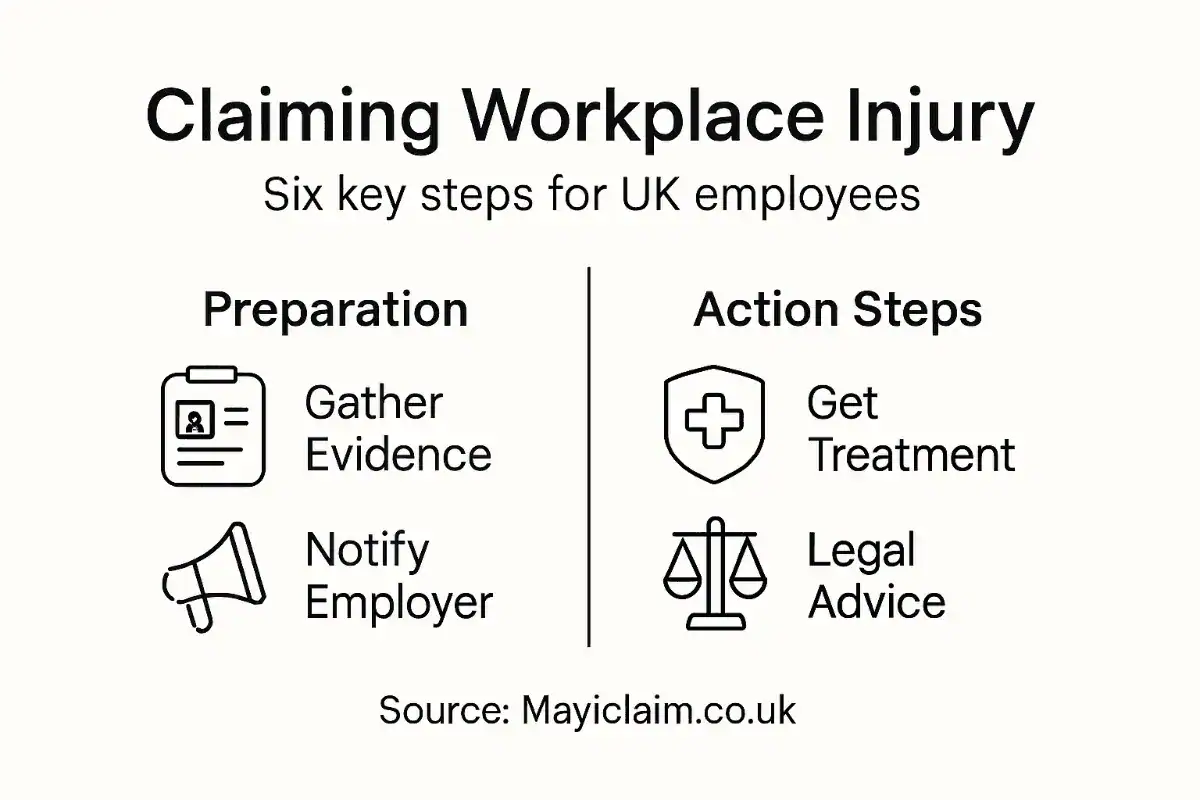
Here is a summary of the roles that different types of evidence play in strengthening your workplace injury claim:
| Type of Evidence | Purpose in Claim | Strength to Case |
| Photographs | Visual proof of conditions | Clarifies what occurred visually |
| Medical Records | Confirms injury and impact | Validates health consequences |
| Incident Reports | Provides official timeline | Establishes employer awareness |
| Witness Statements | Corroborates your account | Adds credibility to incident |
| Work Absence Records | Quantifies financial loss | Supports claim for lost wages |
The more detailed and organised your evidence, the stronger your workplace injury claim will be.
Top tip: Request copies of all medical reports and workplace incident logs immediately, as these documents can become harder to obtain weeks or months after the accident.
Step 2: Notify your employer and complete the accident book
Notifying your employer promptly after a workplace injury is a critical step in protecting your legal rights and potential compensation claim. This process establishes an official record of the incident and ensures your workplace follows necessary safety reporting procedures.
To properly document your workplace injury, you’ll need to take several key actions. Workplace accident reporting guidelines outline specific requirements for employees and employers. Here are the essential steps:
- Inform your direct supervisor immediately after the incident occurs
- Request to complete the workplace accident book
- Ensure all details are accurately recorded
- Ask for a copy of the accident report
- Obtain witness contact information if possible
If your workplace has more than 10 employees, they are legally required to maintain an official accident book. During this process, be precise and factual when describing the incident. Include specific details such as the date, time, location, and circumstances surrounding your injury.
Your detailed and timely reporting creates an essential legal document for any potential compensation claim.
Top tip: Create your own written record of the incident simultaneously, including photographs and personal notes, as a backup to the official workplace documentation.
The following table highlights the differences between official workplace documentation and your personal records during an injury claim:
| Documentation Type | Maintained By | Main Benefit |
| Official Accident Book | Employer | Legal verification of incident |
| Medical Records | Healthcare Providers | Professional documentation |
| Personal Notes & Photos | You (the claimant) | Captures extra detail, backup |
| Solicitor Correspondence | Legal Representative | Documents claim progress |
Step 3: Seek medical attention and keep detailed records
After a workplace injury, obtaining prompt and comprehensive medical attention is crucial for both your health and potential compensation claim. Your medical records will serve as critical evidence documenting the extent and impact of your workplace injury.
Medical documentation for workplace injuries requires careful and thorough approach. Consider the following essential steps:
- Visit your GP or local accident and emergency department immediately
- Request comprehensive medical examinations
- Ensure all injuries are professionally documented
- Obtain copies of all medical reports and treatment plans
- Keep receipts for any medical expenses, including prescriptions and treatments
During medical consultations, be explicit about how the injury occurred at work. Describe the precise circumstances, highlighting any workplace conditions that contributed to your accident. Medical professionals will record these details, which become crucial supporting evidence for your compensation claim.
Your medical records are the most powerful documentation in proving the severity and workplace origin of your injury.
Top tip: Request a complete set of medical records directly from each healthcare provider, ensuring you have comprehensive documentation for your compensation claim.

Step 4: Consult a no-win-no-fee legal expert for advice
Securing professional legal guidance is a critical step in navigating your workplace injury compensation claim. A specialist solicitor can provide invaluable expertise in understanding your rights and maximising your potential compensation.
Workplace injury legal support involves selecting a solicitor who understands the complexities of your specific case. Consider the following key factors when choosing your legal representative:
- Research no-win-no-fee solicitors specialising in workplace injuries
- Check their track record of successful claims
- Verify their professional accreditations
- Request a free initial consultation
- Understand their fee structure before proceeding
During your initial consultation, bring all documented evidence from previous steps. Be prepared to discuss every detail of your workplace injury, including medical records, incident reports, and any witness statements. A skilled solicitor will assess the strength of your claim and provide clear guidance on potential compensation.
A specialist no-win-no-fee solicitor takes financial risk out of pursuing your workplace injury claim.
Top tip: Ask potential solicitors about their specific experience with cases similar to yours, ensuring you choose a legal expert who truly understands workplace injury claims.
Step 5: Submit your workplace injury claim for compensation
Submitting your workplace injury claim is the crucial final step in seeking the compensation you deserve for your suffering and financial losses. This process transforms all your carefully collected evidence into a formal legal request for justice.
Workplace accident compensation claims require precise documentation and strategic presentation. Follow these essential steps to ensure a comprehensive submission:
- Compile all medical documentation
- Prepare a detailed incident report
- Calculate total financial losses
- Draft a clear, factual claim statement
- Submit through your chosen legal representative
Your solicitor will typically handle the technical aspects of claim submission, but your active involvement remains critical. They will review all collected evidence, assess potential compensation ranges, and negotiate on your behalf. Be prepared to provide additional information or clarification if requested during the claims process.
The strength of your claim depends on the quality and comprehensiveness of your supporting evidence.
Top tip: Maintain open communication with your solicitor and respond promptly to any requests, as this can significantly expedite your compensation claim.
Step 6: Verify claim status and secure your settlement
As you approach the final stage of your workplace injury claim, staying proactive and informed becomes crucial to ensuring a successful resolution. This stage involves carefully monitoring your claim’s progress and understanding the settlement negotiation process.
Maintaining clear communication with your legal representative is essential. Here are key actions to take during this critical phase:
- Request regular claim status updates
- Review all settlement documentation thoroughly
- Understand the proposed compensation breakdown
- Ask questions about any unclear terms
- Confirm the final settlement amount
Your solicitor will negotiate on your behalf, but your active participation helps ensure a fair outcome. Pay close attention to the details of the proposed settlement, including compensation for medical expenses, lost wages, and potential future treatment costs.
The final settlement represents more than just financial compensation – it’s recognition of the challenges you’ve experienced.
Top tip: Do not rush the settlement process. Take time to carefully review all documents and consult with your solicitor to ensure you fully understand the terms of your compensation.
Take Control of Your Workplace Injury Claim with Expert Support
Facing the challenge of a workplace injury claim can feel overwhelming with all the evidence gathering, medical documentation, and legal procedures involved. You want to ensure your injury is recognised, your financial losses are covered, and your rights protected. This step-by-step guide highlights the importance of timely reporting, comprehensive evidence, and securing expert advice.

Don’t navigate this complex process alone. At Mayiclaim.co.uk, we specialise in no-win-no-fee personal injury claims across the United Kingdom. Our dedicated legal experts understand the pain points you face – from gathering incident reports to submitting a strong compensation claim. Act now to safeguard your future and maximise your compensation with professional support. Begin your claim today by visiting Mayiclaim.co.uk and get the guidance you need at every stage.
Frequently Asked Questions
How do I gather evidence for my workplace injury claim?
To gather evidence for your workplace injury claim, start by documenting everything related to the accident. This includes taking photographs of the scene and your injuries, collecting medical records, obtaining incident reports, and gathering witness statements.
What should I do immediately after a workplace injury?
Immediately after a workplace injury, inform your direct supervisor and complete the workplace accident book to establish an official record. Make sure to accurately document all details, including date, time, location, and circumstances of the incident.
How can I ensure my medical records support my injury claim?
To ensure your medical records support your injury claim, visit your healthcare provider as soon as possible and clearly explain how the injury occurred in the workplace. Request detailed documentation of your injuries, treatment, and any related expenses.
Why should I consult a no-win-no-fee solicitor for my injury claim?
Consulting a no-win-no-fee solicitor can provide you with expert legal guidance without financial risk. They will assess your claim’s strength, help organise your documentation, and negotiate on your behalf for the compensation you deserve.
What steps are involved in submitting my workplace injury claim?
To submit your workplace injury claim, compile all critical documentation, including medical records and incident reports, and prepare a clear claim statement. Submit these through your selected legal representative, who will handle the technical aspects and negotiations.
How do I stay updated on the status of my workplace injury claim?
To stay updated on your workplace injury claim, request regular status updates from your solicitor and review all correspondence carefully. Understanding the progress and any proposed settlement terms helps ensure you are fully informed and prepared for discussions.
Recent Comments