

A road accident can leave you confused about what steps to take next, especially when injuries and financial worries add to the stress. Understanding the accident claims process is essential for people in the United Kingdom who want to secure fair compensation and support their recovery. This guide explains the structured claims journey, including the benefits of no-win-no-fee agreements, so you can make informed choices about seeking professional legal help after your accident.
Table of Contents
- Defining Accident Claims Process in the UK
- Types of Road Accident Claims Explained
- How No-Win-No-Fee Agreements Work
- Legal Rights and Claimant Responsibilities
- Common Pitfalls and How to Avoid Them
Key Takeaways
| Point | Details |
|---|---|
| Accident Claims Process | Individuals can pursue claims through self-representation or professional legal assistance. Understanding critical components like documentation and liability is essential for success. |
| Types of Claims | Claims include physical injuries, psychological trauma, and property damage, with varying complexities that determine the processing route. |
| No-Win-No-Fee Agreements | These agreements eliminate upfront costs, allowing claimants to pay only upon successful claims, thus reducing financial risk. |
| Claimant Responsibilities | Claimants must gather comprehensive evidence, adhere to procedures, and cooperate with medical assessments to substantiate their claims effectively. |
Defining Accident Claims Process in the UK
The accident claims process in the United Kingdom provides individuals with a structured pathway to seek compensation for injuries and financial losses resulting from road traffic incidents. Compensation claims can be pursued through two primary mechanisms: self-representation or professional legal assistance from solicitors specialising in personal injury law.
Navigating this process requires understanding several critical components:
- Initial Documentation: Gathering comprehensive evidence about the accident
- Medical Assessment: Obtaining professional medical reports documenting injuries
- Liability Determination: Establishing fault and legal responsibility
- Compensation Calculation: Evaluating potential financial recovery
The claims process typically follows a structured sequence designed to assess the merits of an individual’s case. Most claims commence with gathering essential documentation, including police reports, medical records, witness statements, and photographic evidence from the incident scene. These materials form the foundational proof required to substantiate a compensation claim.
Claimants have two primary routes for pursuing compensation. The first involves self-representation, where individuals manage their own claim directly with insurance companies. The second, and often recommended approach, involves engaging professional legal representation who specialise in navigating complex claims procedures.
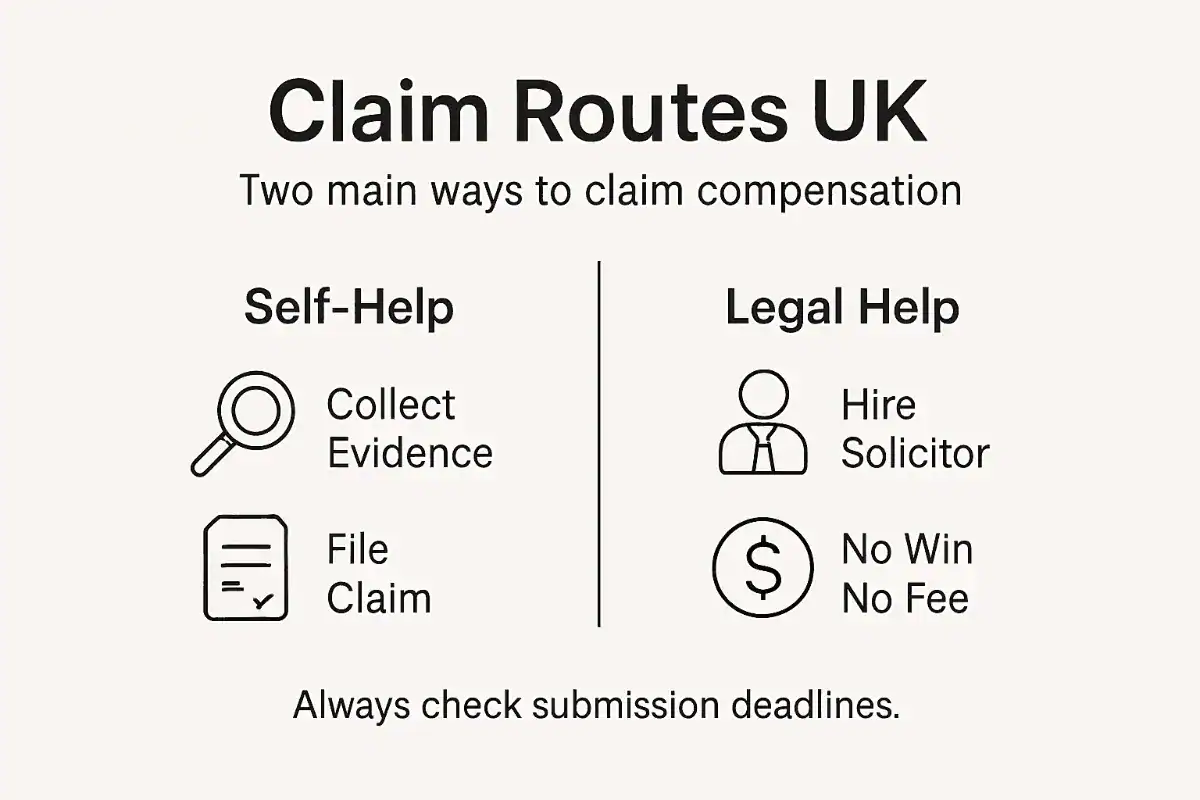
Below is a comparison of self-representation and professional legal assistance in the UK accident claims process:
| Aspect | Self-Representation | Professional Legal Assistance |
|---|---|---|
| Process Complexity | Requires claimant to manage all steps | Solicitor handles legal procedures |
| Financial Risk | No legal fees, but risk of under compensation | Conditional on claim success, fees taken from settlement |
| Success Rate | Lower due to limited expertise | Higher with experienced solicitors |
| Time Investment | Claimant must handle all documentation and follow-ups | Solicitor manages deadlines and paperwork |
Pro tip: Preserve all documentation related to your accident, including medical records, repair estimates, and correspondence, as these become crucial evidence in substantiating your compensation claim.
Types of Road Accident Claims Explained
Road accident claims in the United Kingdom encompass a wide range of scenarios, from minor incidents to more serious collisions. Low-value personal injury claims represent a significant category, covering various types of injuries sustained during road traffic incidents.
The primary categories of road accident claims include:
- Physical Injury Claims
- Whiplash injuries
- Muscle damage
- Cuts and bruises
- Minor and severe fractures
- Psychological Trauma Claims
- Post-traumatic stress
- Anxiety from accident experience
- Property Damage Claims
- Vehicle repair costs
- Replacement of damaged personal items
Claims can arise from multiple scenarios, including negligent driving, road design issues, or mechanical failures. Personal injury compensation typically requires demonstrating fault and proving the extent of damages suffered. This process involves gathering comprehensive medical evidence, documenting financial losses, and establishing a clear link between the accident and the sustained injuries.
Legal professionals often categorise road accident claims based on their complexity and potential compensation value. Minor claims under £5,000 can typically be processed through a digital portal, while more complex cases involving severe injuries may require detailed legal intervention and extensive documentation.
The following table provides a quick guide to claim categories and relevant digital routes based on claim value:
| Claim Category | Typical Claim Value | Processing Route |
|---|---|---|
| Minor Physical Injury | Under £5,000 | Online portal |
| Serious Physical Injury | Above £5,000 | Formal legal process |
| Psychological Trauma | Varies, often under £5,000 | Online or legal route |
| Significant Property Damage | Usually above £1,000 | Claims via insurer or litigation |
Pro tip: Collect and preserve all potential evidence immediately after an accident, including photographs, witness contact details, and medical reports, to strengthen your potential compensation claim.
How No-Win-No-Fee Agreements Work
No-win-no-fee agreements represent a crucial mechanism for individuals seeking legal representation without upfront financial risk. Personal injury claims typically utilise these arrangements, allowing claimants to pursue compensation without immediate legal expenses.
Key characteristics of no-win-no-fee agreements include:
- Financial Protection
- No upfront legal fees
- Solicitor only paid upon successful claim
- Reduced financial risk for claimant
- Cost Structure
- Success fee deducted from compensation
- Insurance to cover potential adverse costs
- Transparent fee arrangements
- Risk Allocation
- Solicitor assumes initial financial risk
- Motivated to pursue strong cases
- Selective case acceptance
Legal aid compensation mechanisms typically operate under strict guidelines. When a claim succeeds, solicitors receive a predetermined percentage of the settlement, usually between 20-25%. This arrangement ensures legal professionals are incentivised to secure the maximum possible compensation while protecting clients from unnecessary financial exposure.

Claimants should carefully review the specific terms of their no-win-no-fee agreement. While these arrangements eliminate upfront costs, they may involve additional expenses such as medical report fees, court charges, or insurance premiums. Understanding the full financial implications is crucial before proceeding with a claim.
Pro tip: Request a comprehensive breakdown of potential fees and charges before signing any no-win-no-fee agreement to avoid unexpected financial obligations.
Legal Rights and Claimant Responsibilities
Navigating the legal landscape of accident claims requires a clear understanding of both rights and obligations. Personal injury compensation fundamentally protects individuals who have suffered harm due to another party’s negligence, providing a legal mechanism for seeking financial redress.
Claimants have several critical responsibilities throughout the claims process:
- Evidence Collection
- Gather comprehensive accident documentation
- Secure medical reports and treatment records
- Photograph incident scene and injuries
- Procedural Compliance
- Adhere to statutory time limits
- Complete all required legal documentation
- Respond promptly to legal correspondence
- Medical Cooperation
- Attend recommended medical assessments
- Provide accurate injury and recovery information
- Follow prescribed medical treatments
Whiplash Reform Programme guidelines outline specific legal obligations for road traffic accident claims. The standard time limit for initiating a claim is three years from the date of the incident, with exceptions for complex cases involving minors or individuals with diminished mental capacity.
Legal rights encompass seeking compensation for various damages, including medical expenses, lost earnings, rehabilitation costs, and pain and suffering. However, these rights come with corresponding responsibilities to provide truthful, comprehensive information and cooperate fully throughout the claims process.
Pro tip: Maintain a detailed personal record of all accident-related expenses, medical treatments, and communications to substantiate your compensation claim effectively.
Common Pitfalls and How to Avoid Them
Navigating accident claims requires strategic awareness of potential challenges that could compromise compensation efforts. Whiplash Reform Programme guidelines highlight several critical areas where claimants frequently encounter complications during the claims process.
Most common pitfalls include:
- Documentation Errors
- Incomplete medical records
- Missing incident reports
- Inadequate photographic evidence
- Procedural Mistakes
- Missing statutory time limits
- Incorrect claim filing
- Failing to respond to legal correspondence
- Evidence Submission Problems
- Inconsistent medical reports
- Insufficient proof of damages
- Unclear injury documentation
The most significant risk involves missing the three-year limitation period for filing claims. This strict deadline means claimants must act promptly and decisively, gathering comprehensive evidence and seeking professional guidance to protect their legal rights.
Claims can be severely compromised by providing incomplete or inaccurate information. Insurance companies and legal professionals scrutinise every detail, and any discrepancies can potentially reduce compensation or invalidate the entire claim. Maintaining meticulous, contemporaneous records of all accident-related expenses, medical treatments, and communications is crucial for substantiating your claim.
Pro tip: Create a dedicated folder immediately after an accident to systematically collect and preserve all relevant documentation, ensuring nothing critical is overlooked.
Navigate Your Accident Claim With Confidence and Expert Support
Understanding the Accident Claims Process can feel overwhelming, especially when facing tight deadlines and complex legal procedures. If you have been injured or suffered losses through no fault of your own, the challenges of collecting evidence, meeting statutory requirements, and pursuing compensation may cause stress and uncertainty. At Mayiclaim.co.uk, we specialise in guiding individuals across the United Kingdom through every step of the claims journey with trusted no-win-no-fee legal representation.

Take control of your claim today and avoid common pitfalls such as missed time limits or incomplete documentation. Our experienced solicitors know the intricacies of no-win-no-fee agreements and can maximise your compensation without upfront costs. Do not let confusion or fear delay your right to compensation. Visit Mayiclaim.co.uk now to access expert advice and begin your claim with confidence.
Frequently Asked Questions
What is the initial step in the accident claims process?
The initial step in the accident claims process is gathering comprehensive documentation related to the accident, which includes police reports, medical records, witness statements, and photographic evidence from the scene.
How do no-win-no-fee agreements work in accident claims?
No-win-no-fee agreements allow individuals to pursue compensation without upfront legal costs. Solicitors are only paid upon the successful resolution of the claim, typically through a success fee deducted from the compensation received.
What types of damages can be claimed after a road accident?
Damages that can be claimed after a road accident include medical expenses, lost earnings, rehabilitation costs, pain and suffering, as well as costs associated with property damage like vehicle repairs or replacement of personal items.
How long do I have to file a claim after an accident?
You generally have three years from the date of the accident to file a claim. However, there are exceptions for complex cases involving minors or individuals with diminished mental capacity.
Recent Comments