

Suffering a workplace injury in the United Kingdom can leave you stressed, facing uncertainty about recovery and your finances. Choosing the right legal support feels daunting, especially when you’re worried about paying solicitor fees upfront. A no win no fee agreement gives you confidence to seek justice, letting you pursue your claim without up-front costs and ensuring your solicitor only gets paid if your case succeeds. This guide clears up how these agreements work, what costs to expect, and how your rights are protected every step of the way.
Table of Contents
- No Win No Fee Agreements Explained
- Types Of Claims Covered In The UK
- How The Claim Process Works In 2026
- Legal Protections And Recent Rule Changes
- Costs, Risks And Comparing Alternatives
Key Takeaways
| Point | Details |
|---|---|
| No Win No Fee Agreements | Conditional Fee Agreements allow claimants to pursue legal action without upfront solicitor fees. Solicitors are paid only if the case is successful, sharing the financial risk. |
| Success Fee Cap | The success fee for personal injury claims is legally capped at 25% of the awarded compensation, ensuring transparency in costs. |
| Potential Additional Costs | Claimants should be aware of other expenses, known as disbursements, which may include court fees and expert reports, and consider after-the-event insurance to cover potential opponent costs. |
| Claim Process Overview | The claim process involves initial assessment, evidence gathering, negotiation, and potential court proceedings, with a clear structure guiding claimants through each stage. |
No win no fee agreements explained
A no win no fee agreement (formally called a Conditional Fee Agreement or CFA) is a legal arrangement that allows you to pursue a claim without paying solicitor fees upfront. Your solicitor only gets paid if your case succeeds, which means they share the financial risk with you.
Here’s how it works in practice:
- You pursue your claim with legal representation from day one
- Your solicitor covers their own costs during the case
- If you lose, you pay nothing to your solicitor
- If you win, your solicitor takes a success fee from your compensation
- The success fee is capped by law at 25% of your personal injury compensation
According to the Solicitors Regulation Authority, Conditional Fee Agreements provide transparency on fees and risks before you commit to anything. Your solicitor must explain what happens if the case fails, what costs you might owe, and how much they’ll take if you succeed.
What costs might you still face?
Whilst your solicitor’s fees are covered under the no win no fee arrangement, other expenses may apply. These are called disbursements and include court fees, expert witness reports, and medical assessments. Your solicitor will discuss these with you upfront.
Many claimants use after-the-event insurance to protect themselves. This insurance covers your opponent’s legal costs if your claim fails, so you’re not left with a large bill. The insurance premium is typically recovered from your compensation if you win.
Why solicitors offer this arrangement
Solicitors take on the risk because they believe in your case. They’ve assessed your claim and feel confident enough to work without upfront payment. This arrangement shifted the financial burden from injured workers to legal professionals, which is why it’s become standard practice.
Your solicitor’s success fee compensates them for taking on the risk and waiting for payment until your case concludes.
The key benefit is access to justice. Without no win no fee agreements, many injured workers couldn’t afford legal representation at all. You get professional support without worrying about mounting legal bills whilst recovering from injury.
Pro tip: Ask your solicitor to explain the success fee structure in writing before signing any agreement, and confirm whether after-the-event insurance is included or if you’ll pay for it separately.
Types of claims covered in the UK
No win no fee agreements cover a surprisingly wide range of civil claims beyond just workplace injuries. Your solicitor can take on your case without upfront fees if they believe you have a reasonable chance of success, regardless of the claim type.
Here are the main categories of claims eligible for no win no fee representation:
- Personal injury claims from car accidents, workplace injuries, and medical negligence
- Employment disputes including unfair dismissal, discrimination, and harassment
- Professional negligence claims against solicitors, accountants, or surveyors
- Financial mis-selling claims involving pensions, mortgages, or investment products
- Holiday and travel accidents resulting in illness or injury abroad
Personal injury claims
Personal injury remains the most common claim type covered by no win no fee agreements. This includes accidents at work, motor vehicle collisions, slip-and-fall incidents, and assaults. Medical negligence claims also fall into this category, covering cases where healthcare professionals breach their duty of care.
Your solicitor will assess whether your injury claim has merit before committing to represent you without upfront fees. They examine evidence, medical reports, and witness statements to evaluate success likelihood.
Employment and discrimination claims
If you’ve been treated unfairly at work, a no win no fee agreement can cover your legal costs. This includes unfair dismissal, unlawful discrimination based on protected characteristics, and wage disputes. Many employment solicitors operate on no win no fee terms because employment law is their speciality.
Professional negligence and financial claims
When professionals like surveyors, architects, or financial advisors fail in their duty, you can claim compensation. Financial mis-selling claims involving pensions or investments are also commonly handled on no win no fee terms.
Solicitors screen all cases before accepting them to ensure a reasonable prospect of success.
Not every claim qualifies. Your solicitor will reject cases they believe are unlikely to succeed, regardless of your wish to proceed. This protects both parties from costly litigation with minimal chance of recovering compensation.
How solicitors evaluate your claim
Before agreeing to represent you, your solicitor considers several factors:
- Strength of evidence supporting your case
- Clarity of liability or breach of duty
- Quantifiable losses and damages
- Likelihood of the defendant having funds to pay
- Complexity and estimated costs
If your solicitor accepts your case, they’re essentially betting on your success. This alignment of interests means they’ll work hard to secure the best outcome for you.
Pro tip: When discussing your claim with a solicitor, be transparent about all facts, even unfavourable ones, so they can accurately assess whether your case meets their success criteria.
How the claim process works in 2026
The claim process on a no win no fee basis follows a structured pathway from initial contact to final resolution. Understanding each stage helps you know what to expect and keeps you prepared throughout your case.
Here’s the typical journey your claim takes:
- Initial enquiry and assessment – You contact a solicitor with details of your injury and accident
- Merit evaluation – Your solicitor reviews evidence to determine if you have a reasonable chance of success
- Conditional Fee Agreement – You sign the no win no fee contract if your case is accepted
- Evidence gathering – Medical reports, witness statements, and expert opinions are collected
- Claim submission – Your solicitor formally notifies the defendant and their insurance company
- Negotiation phase – Both sides discuss settlement options and compensation figures
- Resolution – Your claim settles or proceeds to court if necessary
Getting started with your claim
Your first conversation with a solicitor is crucial. You’ll explain what happened, when it occurred, and how you’ve been affected. The solicitor asks detailed questions to understand liability and the extent of your injuries.
Based on this initial discussion, your solicitor decides whether to take your case. They’re looking for a reasonable prospect of success, which means they believe winning is more likely than losing. If they reject your claim, they’ll explain why and may suggest alternatives.
The Conditional Fee Agreement
Once your solicitor accepts your case, you’ll sign a Conditional Fee Agreement that outlines everything in writing. This document specifies the success fee percentage, what happens if you lose, and which costs you might pay.
Read this agreement carefully before signing. Ask questions about anything unclear. Your solicitor must explain your financial obligations and insurance options for covering opponent costs.
Building your case
Your solicitor gathers evidence to support your claim. This includes medical reports documenting your injuries, witness statements from people present at the accident, and expert opinions about liability or damages.

Medical evidence is particularly important. Your solicitor may instruct medical experts to examine you and write detailed reports about your condition, treatment needs, and long-term prognosis.
Negotiation and settlement
Most claims settle through negotiation rather than court proceedings. Your solicitor contacts the defendant’s insurance company and presents your evidence. They discuss a fair compensation figure based on your injuries, losses, and expenses.
If both sides reach agreement, you receive compensation and your case closes. The solicitor deducts their success fee and any disbursements before sending you the remaining amount.
Most claims resolve through settlement, avoiding the time, stress, and uncertainty of court proceedings.
What if settlement fails?
If negotiation doesn’t produce acceptable results, your case proceeds to court. Your solicitor handles all legal proceedings, presenting your evidence to a judge or jury. Court cases take longer and cost more, but they may result in higher compensation if successful.
Pro tip: Keep detailed records of all accident-related expenses, medical appointments, and how your injury affects daily life, as this evidence strengthens your claim and supports higher compensation figures.
Legal protections and recent rule changes
The legal landscape governing no win no fee agreements has tightened significantly in 2026. New rules protect injured workers from unscrupulous practices whilst maintaining access to affordable legal representation.
Understanding your rights under these protections helps you identify trustworthy solicitors and avoid firms cutting corners.
What the law requires from solicitors
Solicitors handling no win no fee cases must comply with strict regulations. The Courts and Legal Services Act 1990 governs Conditional Fee Agreements and sets out mandatory requirements for clarity and transparency.
Your solicitor must provide you with:
- Written explanation of the success fee and when it’s payable
- Clear information about other costs you might owe
- Details of after-the-event insurance options
- Confirmation of funding alternatives if available
- An accessible summary before you commit to anything
The 2026 SRA crackdown
The Solicitors Regulation Authority identified serious problems in high-volume claims handling. Poor practices included lack of transparency on fees, inadequate due diligence on referrals, and misleading marketing tactics pushing unnecessary claims.
The SRA now conducts regular investigations and strengthened oversight. Firms caught breaching rules face disciplinary action, fines, or closure. This means you’re better protected against exploitation than ever before.
Your financial protections
Success fees are now strictly regulated. Solicitors cannot charge more than 25% of your personal injury compensation, and this fee comes from your damages, not from the defendant.
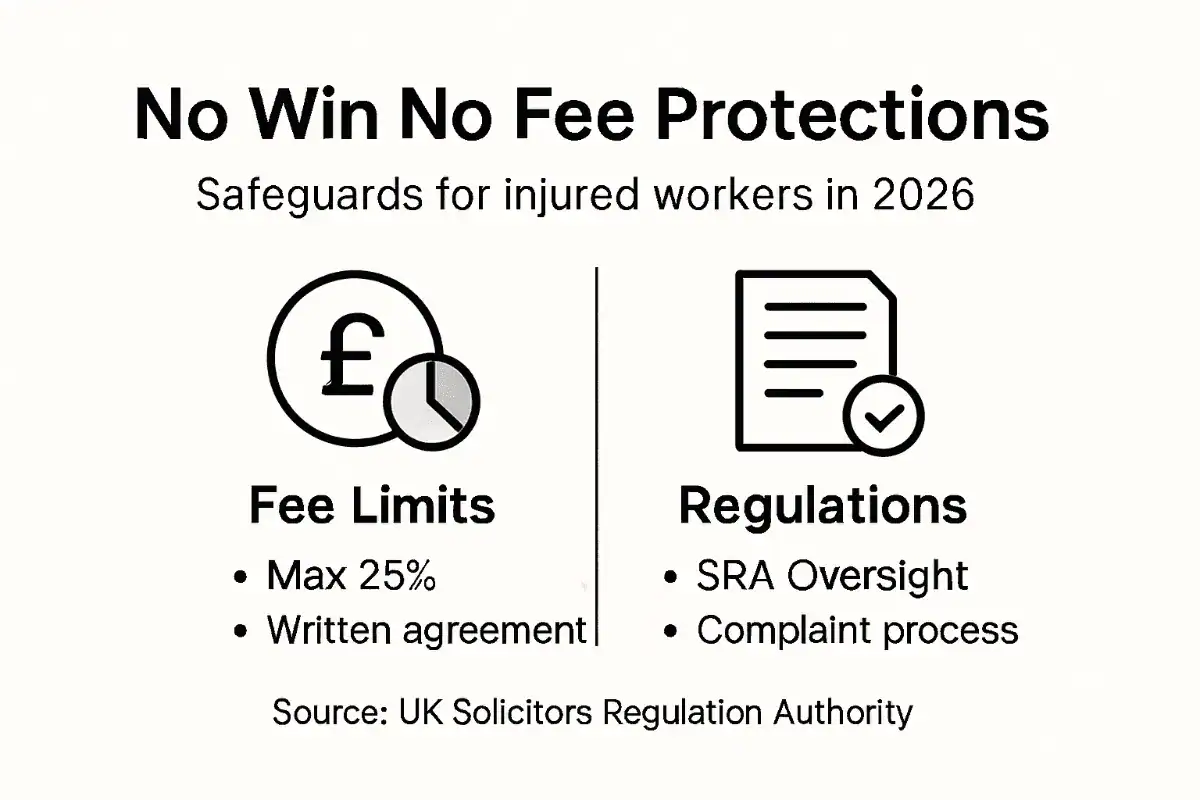
If a Conditional Fee Agreement is vague or non-compliant, it becomes unenforceable. This protects you from unexpected bills or disputes about what you owe.
To summarise protections for claimants, review this table:
| Protection Type | What it Means | Who Enforces It |
|---|---|---|
| Success fee cap | Maximum 25% of compensation | SRA and legislation |
| Written agreement | Must detail all charges clearly | SRA and courts |
| Transparency | Full disclosure of all fees | SRA regulatory checks |
| Complaint rights | Can report solicitors to SRA | SRA investigates |
Key protections against misconduct
Your solicitor cannot:
- Charge upfront fees before accepting your case on no win no fee terms
- Mislead you about your chances of success
- Push you towards unnecessary claims or litigation
- Fail to explain all costs and fees in plain language
- Use unclear agreements that hide financial obligations
Non-compliant agreements risk being unenforceable, meaning you pay nothing and keep all compensation.
What happens if something goes wrong
If your solicitor breaches regulations, you can complain to the SRA. The SRA investigates misconduct and can force firms to refund fees or provide compensation. You can also pursue a professional negligence claim against your solicitor if they cause you financial loss through poor handling of your case.
Choosing a regulated solicitor
Always verify your solicitor is regulated by the SRA before signing anything. Check their online register, ask for their SRA reference number, and read independent reviews. Regulated firms display clear information about complaints procedures and professional indemnity insurance.
Pro tip: Request your no win no fee agreement in writing and ask your solicitor to explain every clause in plain language before you sign; if they rush you or refuse to clarify terms, consider finding another firm.
Costs, risks and comparing alternatives
No win no fee agreements reduce upfront financial barriers, but they don’t eliminate all costs or risks. Understanding what you might pay helps you make an informed decision about pursuing your claim.
Most injured workers find the arrangement worthwhile, but transparency matters. Hidden costs or unexpected bills can leave you frustrated even after a successful claim.
What costs might you face?
Your solicitor’s fees are covered under no win no fee, but other expenses apply. These disbursements include court fees, expert witness reports, medical assessments, and administrative costs. Your solicitor discusses these upfront and typically recovers them from compensation if you win.
After-the-event (ATE) insurance protects you against paying the opponent’s legal costs if your claim fails. The insurance premium is substantial—sometimes hundreds of pounds—but it’s recovered from damages if you succeed. Without ATE insurance, you risk owing the defendant’s legal fees.
The success fee is the final cost. This is capped at 25% for personal injury claims and comes directly from your compensation, reducing what you receive.
Hidden risks to watch for
Unexpected charges can arise if your claim is withdrawn, insurance exclusions apply, or provider mismanagement occurs. Some firms deduct substantial amounts before sending final compensation.
Withdrawing a claim partway through creates financial exposure. You may owe your solicitor’s costs up to that point or become liable for opponent costs. Always clarify withdrawal terms before signing.
Comparing funding alternatives
No win no fee isn’t your only option. Understanding alternatives helps you choose the best approach for your situation.
Traditional hourly fees mean you pay as work progresses, regardless of outcome. This suits strong cases where you want control but costs money upfront.
Damages-based agreements mean your solicitor takes a percentage of compensation (typically higher than the 25% no win no fee cap) and nothing if you lose. This aligns incentives completely but costs more if successful.
Legal aid is available for some claims involving vulnerable people or public interest issues. Contact your solicitor about eligibility.
Here’s a quick comparison of common claim funding options in the UK:
| Funding Method | Upfront Costs | Risk if Case Fails | Typical Success Fee |
|---|---|---|---|
| No win no fee | None | Usually minimal | Up to 25% of award |
| Hourly fees | Pay as you go | All fees | None |
| Damages-based | None | Usually minimal | Often above 25% |
| Legal aid | Often none | Very low | None |
The best funding method depends on your case strength, financial situation, and risk tolerance.
Questions to ask your solicitor
Before committing to any arrangement, ask:
- What happens if I withdraw my claim?
- Are all disbursements explained and recoverable from damages?
- Is ATE insurance included or do I pay separately?
- What’s the exact success fee percentage?
- Are there any circumstances where I pay fees despite losing?
- What complaints process exists if I’m unhappy?
Pro tip: Request a detailed cost breakdown in writing and ask your solicitor to explain the worst-case financial scenario, so you understand maximum exposure before accepting representation.
Secure Expert No Win No Fee Legal Support for Injured Workers Today
Navigating the complexities of a no win no fee agreement can feel overwhelming especially when facing injury and financial uncertainty. This article highlighted key challenges such as understanding conditional fee agreements, managing success fees capped at 25 percent, and protecting yourself with after-the-event insurance. If you want clear transparent guidance and professional representation that shares your risk and fights for your compensation you are not alone.
At Mayiclaim.co.uk, we specialise in connecting injured individuals across the United Kingdom with expert solicitors who operate on a no win no fee basis. Our commitment ensures you gain access to justice without upfront costs or hidden charges. We empower you with straightforward contracts, transparent success fee structures, and support throughout your claim from initial case evaluation to settlement or court resolution. Understand your rights and minimise financial risks today by working with solicitors who put your interests first.
Take control of your claim now with trusted no win no fee legal representation tailored to your specific injury type and circumstance. Visit our site and learn more about how we protect your rights and maximise your compensation at here.

Don’t wait while legal deadlines approach and financial worries grow. Start your no win no fee claim with confidence and clarity at Mayiclaim.co.uk. Get the professional support you deserve and take the first step toward justice today.
Frequently Asked Questions
What is a no win no fee agreement?
A no win no fee agreement, formally known as a Conditional Fee Agreement (CFA), allows you to pursue a legal claim without paying solicitor fees upfront. Your solicitor only receives payment if your case is successful, sharing the financial risk with you.
What costs am I responsible for with a no win no fee agreement?
While your solicitor’s fees are covered under a no win no fee agreement, you may still face other costs called disbursements. These can include court fees, expert witness reports, and medical assessments.
How does the success fee work in a no win no fee agreement?
If your case is successful, your solicitor will take a success fee from your compensation, which is capped by law at 25% of your personal injury compensation. This fee compensates them for taking on the risk of representing you without upfront payment.
Are there legal protections for clients using no win no fee agreements?
Yes, new regulations have tightened protections for clients. Solicitors must provide clear information about their success fees, any other costs, and options for after-the-event insurance, ensuring transparency and fairness in the process.
Recent Comments