

Serious injuries from road traffic accidents turn daily life upside down, leaving many facing uncertainty about their legal options and financial recovery in the United Kingdom. Understanding the full scope of a solicitor’s role can quickly ease some of this stress, especially for those considering no-win-no-fee legal representation. This guide offers a clear look at how professional support can help you uphold your rights, manage the claim process, and move towards the compensation you deserve.
Table of Contents
- Defining A Solicitor’s Role In Injury Claims
- Types Of Injury Claims Handled By Solicitors
- No-Win-No-Fee Arrangements Explained
- The Legal Process For Personal Injury Claims
- Your Rights And Solicitor’s Duties In The UK
Key Takeaways
| Point | Details |
|---|---|
| Solicitors’ Integral Role | Solicitors are essential in personal injury claims, providing legal advice and representing clients throughout the compensation process. |
| Specialised Knowledge Required | Different types of injury claims necessitate specific legal expertise, from road traffic accidents to clinical negligence, ensuring tailored representation. |
| No-Win-No-Fee Arrangements | These arrangements enhance access to legal representation by removing financial barriers, aligning the solicitor’s incentives with the client’s success. |
| Client Rights and Solicitor Duties | Clients are entitled to transparent communication and ethical representation, with solicitors obligated to uphold high professional standards. |
Defining a Solicitor’s Role in Injury Claims
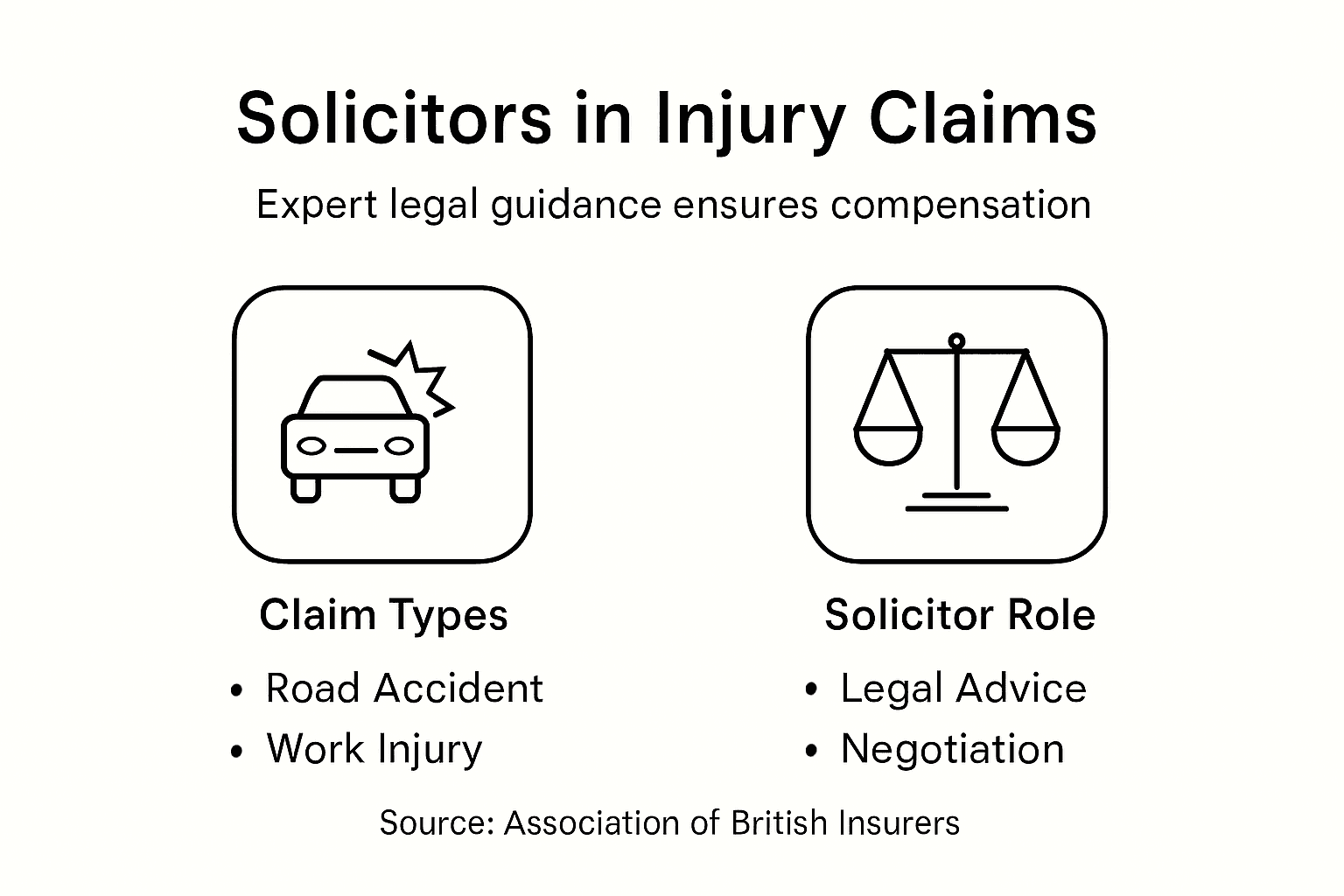
Solicitors play a critical role in personal injury claims, serving as professional legal advocates who guide individuals through complex compensation processes. Their expertise transforms what could be an overwhelming legal journey into a structured, manageable pathway towards justice.
According to the Solicitors Regulation Authority guidance, solicitors are responsible for multiple crucial aspects of injury claims management:
- Providing comprehensive legal advice
- Investigating claim details
- Representing clients during negotiations
- Ensuring compliance with legal standards
- Protecting consumer interests
Their professional responsibilities extend far beyond simple paperwork. Legal representation means thoroughly understanding each client’s unique circumstances and building a compelling case that maximises potential compensation.
Solicitors navigate intricate legal procedures, including managing claims through official portals and securing appropriate medical evidence. They understand how recent legislative reforms impact claim values and procedures, ensuring clients receive fair treatment under current UK regulations.
Key responsibilities of injury claim solicitors include:
- Initial claim assessment
- Gathering supporting documentation
- Negotiating with insurance companies
- Representing clients in court if necessary
- Providing transparent fee structures
Professional expertise is particularly crucial when dealing with complex injury claims involving significant medical evidence or disputed liability. Solicitors transform technical legal language into understandable guidance, empowering clients to make informed decisions about their compensation claims.
A skilled solicitor doesn’t just process a claim – they advocate for the client’s complete legal and financial recovery.
Pro tip: Always request detailed information about a solicitor’s specific experience with injury claims similar to your own before engaging their services.
Types of Injury Claims Handled by Solicitors
Solicitors play a crucial role in managing a diverse range of personal injury claims across the United Kingdom, addressing various scenarios where individuals suffer harm due to negligence or accidents. Citizens Advice highlights the comprehensive scope of injury claims that legal professionals routinely handle.
The primary categories of injury claims managed by solicitors include:
- Road Traffic Accidents: Collisions involving cars, motorcycles, lorries, and pedestrians
- Workplace Injuries: Accidents occurring in professional environments
- Public Liability Claims: Incidents on business or public property
- Clinical Negligence: Medical treatment errors or substandard care
- Slips, Trips, and Falls: Accidents in public or private spaces
According to the Association of British Insurers, recent legislative changes like the Civil Liability Act 2018 have significantly impacted how solicitors process and manage injury claims, particularly for whiplash and minor injury cases.
Each type of injury claim requires specific legal expertise. Road traffic accidents often involve complex insurance negotiations, while workplace injuries demand thorough investigation of employer liability and workplace safety standards. Clinical negligence claims are particularly intricate, requiring detailed medical evidence and expert testimony.

Here’s a summary of how different injury claim types require distinct legal approaches:
| Claim Type | Common Complexity | Specialist Requirement |
|---|---|---|
| Road Traffic Accident | Insurance negotiation | Vehicle law and liability |
| Workplace Injury | Employer responsibility | Health and safety expertise |
| Public Liability | Public risk assessment | Knowledge of occupiers’ law |
| Clinical Negligence | Complex medical evidence | Medical expert consultation |
| Slips, Trips, and Falls | Varying setting disputes | Analysis of maintenance records |
Key considerations for different injury claim types include:
- Establishing clear negligence
- Gathering comprehensive medical documentation
- Adhering to strict legal time limits
- Calculating appropriate compensation
- Navigating specific legal frameworks
Not all injury claims are identical – each requires a tailored legal approach that considers unique circumstances and potential complexities.
Pro tip: Collect and preserve all relevant documentation from the moment of injury, as this can significantly strengthen your potential compensation claim.
No-Win-No-Fee Arrangements Explained
No-win-no-fee arrangements have revolutionised legal access for individuals seeking compensation, removing traditional financial barriers to pursuing personal injury claims. Citizens Advice explains these conditional fee agreements as a critical mechanism for ensuring justice remains accessible to all.
Key characteristics of no-win-no-fee arrangements include:
- Zero upfront legal fees
- Payment only upon successful claim resolution
- Risk mitigation for claimants
- Transparent fee structures
- Incentivised legal representation
The fundamental principle of these agreements is straightforward. Solicitors assume the financial risk by agreeing to represent clients without immediate payment, receiving compensation only if the claim succeeds. This model aligns the solicitor’s interests directly with the client’s, encouraging thorough and committed legal representation.
Legal Ombudsman guidelines outline several critical components of these arrangements:
- Initial free case assessment
- Comprehensive claim investigation
- Potential success fee deduction
- Insurance to cover potential adverse costs
- Clear contractual terms
Success fees typically range between 20-25% of the total compensation, though this varies depending on claim complexity. This percentage compensates solicitors for taking on cases with inherent risk and covering potential unsuccessful claims.
Consider how success fees and insurance impact a no-win-no-fee claim:
| Factor | Typical Range | Impact on Claimant |
|---|---|---|
| Success Fee | 20–25% of compensation | Reduces final payout |
| ATE Insurance | Varies by case | Protects against losing costs |
| Upfront Fees | None | Removes initial financial risk |
No-win-no-fee arrangements democratise legal representation, ensuring individuals can seek justice regardless of their financial circumstances.
Pro tip: Always request a detailed breakdown of potential fees and understand exactly how the success fee will be calculated before signing any no-win-no-fee agreement.
The Legal Process for Personal Injury Claims
Personal injury claims involve a structured legal journey that transforms an individual’s experience of harm into a potential compensation pathway. Legal Ombudsman guidelines provide comprehensive insight into the intricate steps solicitors navigate during these complex legal proceedings.
The initial stages of a personal injury claim typically involve:
- Detailed evidence collection
- Medical assessment and documentation
- Liability investigation
- Preliminary claim valuation
- Risk and merit evaluation
Initial consultation marks the critical first step, where solicitors assess the claim’s potential success. During this phase, claimants provide comprehensive details about their injury, including circumstances, medical treatments, and potential long-term impacts.
Law Society recommendations outline the subsequent claim progression:
- Formal legal investigation
- Medical evidence compilation
- Defendant notification
- Negotiation or litigation preparation
- Settlement or court proceedings
The duration of personal injury claims varies significantly. Straightforward cases might resolve within months, while complex scenarios involving severe injuries or disputed liability could extend over several years. Solicitors continuously evaluate and strategise to secure the most favourable outcome for their clients.
Each personal injury claim represents a unique legal journey, requiring tailored professional expertise and strategic navigation.
Pro tip: Maintain a comprehensive documentation file from the moment of injury, including medical records, witness statements, and correspondence, to strengthen your potential compensation claim.
Your Rights and Solicitor’s Duties in the UK
The relationship between clients and solicitors in personal injury claims is governed by a comprehensive set of professional standards and legal obligations. Solicitors Regulation Authority guidelines establish clear expectations for legal representation and client protection.
Key client rights in the injury claims process include:
- Transparent communication about case progress
- Confidential handling of personal information
- Honest and impartial legal advice
- Clear explanation of potential claim outcomes
- Professional conduct throughout proceedings
Professional duties require solicitors to act with the highest level of integrity, maintaining a strict ethical framework that prioritises the client’s best interests. This means providing comprehensive, unbiased guidance and avoiding any potential conflicts of interest.
Citizens Advice outlines several critical responsibilities solicitors must uphold:
- Maintaining absolute client confidentiality
- Providing clear and comprehensible legal advice
- Pursuing claims with diligence and professional skill
- Explaining potential risks and likely outcomes
- Ensuring fair and ethical representation
Regulatory compliance is paramount, with solicitors required to adhere to strict professional standards set by bodies like the Solicitors Regulation Authority. This ensures clients receive protection, fair treatment, and high-quality legal representation throughout their injury claim process.
A solicitor’s primary duty is not just to win a case, but to serve the client’s best interests with integrity and professional expertise.
Pro tip: Always request a written document outlining your solicitor’s specific duties and your rights at the beginning of your legal representation.
Unlock the Power of Expert Legal Support for Your Injury Claim
Navigating the complex legal landscape after an injury can feel overwhelming. The article highlights critical challenges like understanding intricate legal procedures, securing medical evidence, and managing negotiations with insurance companies. Many people face uncertainty about solicitor duties, no-win-no-fee arrangements, and how to maximise compensation. You deserve a solicitor who will guide you clearly and fight tirelessly for your rightful settlement.
At Mayiclaim.co.uk, we specialise in helping people across the United Kingdom transform these challenges into opportunities for justice. Our experienced solicitors work on a no-win-no-fee basis, removing upfront financial risk while providing expert legal advice tailored to your unique case. Whether your claim stems from a road traffic accident, workplace injury, or slip and fall, our team understands the specific nuances of your situation and can provide transparent guidance every step of the way.
Reach out now for a free initial assessment and take control of your claim with confidence. Visit Mayiclaim.co.uk and discover how our expert solicitors can unlock the full compensation you deserve.

Don’t wait for the complications to grow. Secure dedicated legal help today and move closer to the justice you deserve. Start your journey with Mayiclaim.co.uk and experience the difference expert representation makes.
Frequently Asked Questions
What is the role of a solicitor in personal injury claims?
Solicitors provide legal advice, investigate claim details, represent clients during negotiations, and ensure compliance with legal standards to maximise compensation.
How do solicitors assess the potential of an injury claim?
Solicitors conduct an initial consultation where they evaluate the details of the injury, the circumstances surrounding it, and the medical documentation to determine the claim’s merit and potential success.
What are no-win-no-fee arrangements and how do they work?
No-win-no-fee arrangements allow individuals to pursue personal injury claims without upfront legal fees, paying only if the claim is successful, which mitigates financial risk for claimants.
How long does the personal injury claims process typically take?
The duration of personal injury claims can vary significantly; straightforward cases might be resolved within months, while more complex claims may take several years due to detailed investigations and negotiations.
Recent Comments