

After a road traffic accident, frustration often grows when confusing information and common myths make claiming compensation feel overwhelming. For many across the United Kingdom, worry about exaggerated claims and costs can put them off pursuing what they rightfully deserve. This guide untangles common misunderstandings and highlights legal protections for genuine claimants, so you can make informed decisions about personal injury compensation.
Table of Contents
- Personal Injury Claims And Common Misconceptions
- Types Of Accidents And Compensation Categories
- Legal Principles And Eligibility Requirements
- Rights, Obligations, And Risks For Claimants
- Financial Implications And Benefits Of Claiming
Key Takeaways
| Point | Details |
|---|---|
| Personal Injury Claims Require Evidence | You must prove negligence and quantifiable losses to qualify for compensation, not just the existence of an injury. |
| Claims Take Time to Resolve | Many personal injury claims can take months or years to settle, and not all require immediate legal representation. |
| Myths Can Mislead Claimants | Misconceptions, such as all injuries warranting a claim or quick compensation, can prevent legitimate claims from being pursued. |
| Legal Protection Exists for Honest Claimants | The law is designed to safeguard genuine claimants, and proper documentation supports the validity of claims. |
Personal injury claims and common misconceptions
Many people believe personal injury claims are easy money. This misconception creates unrealistic expectations and often prevents legitimate claimants from pursuing valid cases. The reality is far more nuanced.
One widespread myth is that every accident automatically entitles you to compensation. This simply isn’t true. You must prove that someone else’s negligence caused your injuries. Claiming after an accident involves specific legal requirements that go beyond simply having been hurt.
Another common misconception concerns fraudulent and exaggerated claims damaging your chances. You might worry that dishonest claimants have ruined it for everyone. However, courts can only strike out dishonest or exaggerated claims in exceptional circumstances, meaning genuine claimants remain protected by law.
The law exists to protect honest claimants, not to punish them for fraud committed by others.
Some people assume all claims get resolved quickly and easily. This isn’t the case. Not all claims are straightforward, and some involve costs and risks. Settlement timelines vary significantly depending on claim complexity and liability disputes.
Here are some key misconceptions worth clearing up:
- You need a solicitor immediately – Many cases settle through complaint procedures or mediation first
- You’ll get compensation quickly – Claims can take months or years depending on circumstances
- Every injury warrants a claim – You must prove negligence and quantifiable losses
- Claims always go to court – Most resolve through negotiation or alternative dispute resolution
- You’ll lose money on legal fees – No-win-no-fee arrangements mean no upfront costs for genuine cases
Another myth suggests that claiming makes you a “benefits cheat.” Personal injury compensation isn’t a benefit. It’s legal redress for losses caused by someone else’s negligence. These are fundamentally different legal concepts.
People also believe that minor injuries don’t deserve claims. Even whiplash from a road traffic accident can have lasting effects on your health, work capability, and quality of life. Your claim recognises genuine harm, not just severity.
Pro tip: _Speak with a no-win-no-fee solicitor about your specific circumstances before assuming your claim doesn’t have merit—honest claimants deserve legal protection.
Types of accidents and compensation categories
Personal injury claims arise from different types of accidents, each with distinct compensation frameworks. Understanding which category your accident falls into helps clarify what you might claim and the process involved.
Road traffic accidents remain the most common source of personal injury claims in the UK. These include collisions, motorcycle accidents, and pedestrian incidents. The Civil Liability Act 2018 outlines compensation frameworks for motor accidents, particularly focusing on whiplash claims and measures to reduce fraudulent claims whilst protecting genuinely injured claimants.
Workplace accidents form another significant category. These occur when employers fail to meet health and safety obligations. Workplace injuries can be claimed under civil law through employer liability claims when negligence causes harm to employees.
Different accident types have different compensation pathways, but the core principle remains the same: proving negligence.
Accidents in public spaces represent a third major category. Slips, trips, and falls in shops, restaurants, or other venues may constitute claims if the property owner was negligent. Public liability claims cover these situations where someone else’s failure to maintain safe conditions caused your injury.
Here are the main accident categories and their characteristics:
- Road traffic accidents – Vehicle collisions, whiplash injuries, pedestrian accidents
- Workplace accidents – Falls, equipment failures, unsafe conditions, employer negligence
- Public liability incidents – Slips and falls in shops, restaurants, or public spaces
- Medical negligence – Surgical errors, misdiagnosis, delayed treatment
- Assault and violence – Personal attacks causing injury
Compensation categories vary based on the type of claim. General damages cover pain, suffering, and loss of quality of life. Special damages reimburse actual losses like medical expenses, lost wages, and travel costs for treatment.
Road traffic accident claims typically involve personal injury protection and third-party liability. Workplace claims often involve employer’s liability insurance. Public space claims rely on public liability insurance held by businesses.
The severity of your injury determines compensation levels, not the accident type alone. A minor whiplash claim differs vastly from serious spinal injury compensation, regardless of whether both resulted from road traffic accidents.
To clarify typical personal injury claims, here is a comparison of accident types, liability, and common compensation elements:
| Accident Type | Typical Liable Party | Usual Compensation Sources |
|---|---|---|
| Road traffic accident | Negligent drivers | Third-party motor insurance |
| Workplace accident | Employer | Employer’s liability insurance |
| Public liability | Property/business owner | Public liability insurance |
| Medical negligence | Healthcare provider | Indemnity schemes/insurers |
| Assault or violence | Criminal or third party | Criminal Injuries Compensation Authority |
Pro tip: Document everything immediately after your accident—photographs, witness details, medical records, and expenses—as this evidence directly supports compensation claims across all accident categories.
Legal principles and eligibility requirements
Understanding the legal framework that governs personal injury claims is crucial to determining whether you have a viable case. The UK operates under distinct legal systems in England, Wales, and Scotland, each with specific principles and eligibility criteria.
To qualify for a personal injury claim, you must establish negligence. This means proving that someone owed you a duty of care, breached that duty, and their breach caused your injury and losses. Without negligence, you have no claim, regardless of how seriously you were hurt.
The duty of care is the foundation of personal injury law. Everyone has a responsibility not to injure others through careless behaviour. Drivers must drive safely, employers must provide safe workplaces, and property owners must maintain safe premises.
The Pre-Action Protocol for Personal Injury Claims outlines procedural requirements governing claims in England and Wales, including steps to notify defendants, evidence disclosure, and expert involvement before litigation begins.
You must prove that someone’s negligence caused your specific injury—general carelessness isn’t enough.
Eligibility also depends on causation. Your injury must be a direct result of the defendant’s negligence. If you were injured through your own fault or circumstances beyond anyone’s control, you may not qualify, or your compensation might reduce proportionally.
Damages must be quantifiable. You can claim for measurable losses: medical treatment costs, lost earnings, rehabilitation expenses, and pain and suffering. Vague or speculative losses don’t qualify.
Key eligibility requirements include:
- Defendant owed you a duty of care
- Defendant breached that duty through negligence
- Breach directly caused your injury
- You suffered quantifiable losses
- Claim made within the limitation period (typically three years from injury date)
- Your injury caused genuine harm and damage
In Scotland, personal injury law principles determine who qualifies for damages and what constitutes eligible claims, with specific definitions of relatives and treatment of future payments for injuries.
The limitation period is critical. Most personal injury claims must be filed within three years of the accident date. Missing this deadline typically means losing your right to claim entirely, though exceptions exist for cases involving children or incapacity.
Proof standards matter too. You must prove your case on balance of probabilities, meaning it’s more likely than not that negligence occurred. This differs from criminal standards requiring proof beyond reasonable doubt.
Pro tip: Contact a solicitor promptly after your accident to ensure you understand the three-year limitation deadline and begin gathering evidence whilst memories and documentation are fresh.
Rights, obligations, and risks for claimants
As a claimant, you possess specific legal rights when pursuing personal injury compensation. Understanding these rights alongside your obligations and potential risks ensures you make informed decisions throughout the claims process.

Your primary right is to seek compensation for genuine injuries caused by someone else’s negligence. You can pursue this claim directly with the defendant’s insurer or through authorised representatives. You have the right to claim compensation directly or through legitimate claims management companies, though choosing reputable representation matters significantly.
You also have the right to access legal advice before committing to any claim. Many solicitors offer free initial consultations to assess your case viability and explain your options clearly.
Your right to claim doesn’t come without obligations—transparency and honesty are non-negotiable throughout the process.
One critical obligation is providing complete and truthful information. You must disclose all facts, medical history, and evidence. Exaggerating injuries or withholding information can invalidate your claim and result in serious legal consequences.
You’re also obligated to mitigate your losses. This means taking reasonable steps to reduce harm and recover. Ignoring medical advice or refusing treatment weakens your claim and reduces compensation.
Key rights and obligations include:
- Right to legal representation and free initial advice
- Obligation to provide complete, truthful evidence
- Right to no-win-no-fee arrangements in eligible cases
- Obligation to follow medical advice and treatment recommendations
- Right to dispute rejected claims through proper channels
- Obligation to cooperate with solicitors and provide requested information promptly
Risks exist even with legitimate claims. If your claim is rejected, you may face defendant’s legal costs under certain circumstances. High-value cases involve financial and reputational risks if claims are disputed or rejected, particularly when specialist counsel involvement is required.
Delays in pursuing your claim carry risks too. Missing the three-year limitation deadline means losing your right to claim entirely. Waiting too long also weakens evidence quality as memories fade and documentation becomes harder to locate.
Another risk involves choosing unregulated claims management companies. Some charge excessive fees or operate dishonestly, damaging your case. Only use FCA-regulated solicitors or authorised claims management companies verified through official registers.
Financial risks include potential cost orders if your claim fails, though no-win-no-fee arrangements protect you from paying solicitor fees if you lose. However, you may still face court costs ordered against you in exceptional circumstances.
Pro tip: Always verify your solicitor’s credentials through the Solicitors Regulation Authority register and confirm they operate on a genuine no-win-no-fee basis before signing any agreements.
Financial implications and benefits of claiming
Claiming personal injury compensation carries both financial benefits and costs you should understand before proceeding. Knowing what you might receive and what it could cost helps you make realistic decisions about your claim.
The primary benefit is compensation for tangible losses. Damages cover pain and suffering as well as loss of earnings caused by your injury, meaning you recover money for genuine harm experienced. This includes medical expenses, rehabilitation costs, lost wages, and reduced quality of life.
General damages compensate for pain, suffering, and loss of amenity. These vary based on injury severity and recovery timeline. A minor whiplash claim might yield £2,000–£5,000, whilst serious spinal injuries could reach £50,000 or significantly more.
Special damages reimburse specific, quantifiable losses. Medical treatment costs, physiotherapy sessions, travel for appointments, and wages lost whilst recovering all qualify. Keep receipts and documentation for every expense.
The financial benefit of claiming lies not just in compensation, but in holding negligent parties accountable for genuine harm.
The Civil Liability Act 2018 adjusted how compensation gets calculated to balance fair awards with sustainable insurance costs, influencing the actual amounts claimants receive across different injury types.
Financial benefits include:
- Pain and suffering compensation for documented injuries
- Lost earnings recovery during treatment and recovery periods
- Medical expense reimbursement for all treatment costs
- Future care costs if your injury causes lasting disability
- Travel and accommodation expenses related to treatment
- Reduced pension contributions if you cannot work
Financial implications deserve careful consideration. Legal fees represent a significant concern, though no-win-no-fee arrangements eliminate upfront solicitor costs. You only pay a success fee (typically 25% of compensation) if your claim succeeds.
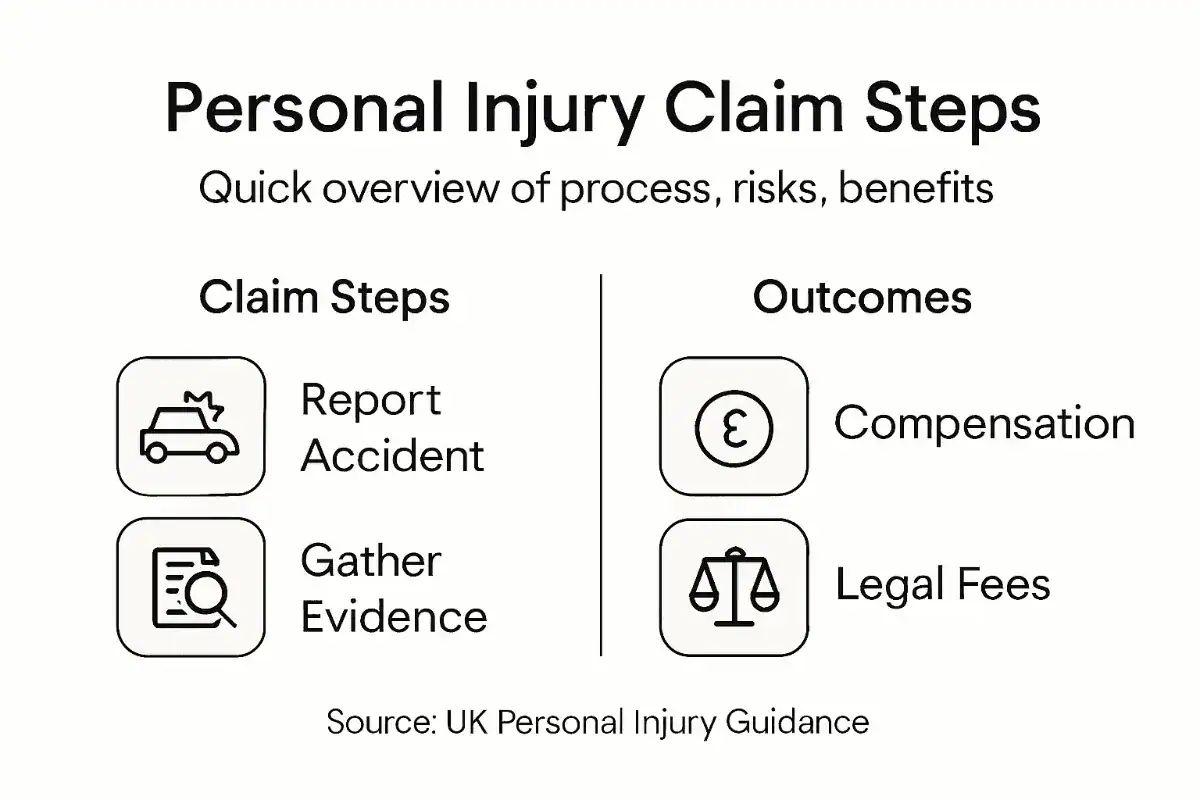
Court costs present another risk. If your claim fails, the defendant might recover their legal expenses from you. However, no-win-no-fee agreements usually include after-the-event insurance protecting you from these costs.
Delays in settlement reduce financial benefit. Compensation doesn’t accrue interest, so waiting years means no growth on your award. Additionally, unresolved claims create ongoing financial stress and uncertainty.
Underestimating your losses leads to lower compensation. Many claimants fail to claim for all eligible expenses, accepting settlements below what they deserve. Detailed record-keeping prevents this costly mistake.
Inflation also affects your compensation. Future care costs and ongoing treatment require adjustment for rising prices, something solicitors factor into long-term settlements.
The table below highlights financial outcomes and risks associated with personal injury claims:
| Aspect | Potential Benefit | Possible Risk |
|---|---|---|
| Compensation | Covers pain, loss, expenses | Settlement delays reduce value |
| Legal costs | No-win-no-fee protects upfront fees | Losing might mean some cost orders |
| Documentation | Increases award value | Missing records lower compensation |
| Time limitation | Timely claim preserves right | Late claim forfeits compensation |
| Representation | Regulated solicitors ensure fairness | Unregulated firms risk losses |
Pro tip: Keep comprehensive records of every expense related to your injury—medical bills, prescriptions, travel costs, and lost wages—as detailed documentation directly increases your compensation amount.
Secure Your Legal Rights with Expert No-Win-No-Fee Support
Understanding your entitlement to claim personal injury compensation can often seem overwhelming. The article highlights crucial challenges such as proving negligence, managing legal obligations, and navigating the complex compensation categories. If you are facing uncertainty about proving your case or worried about legal fees and deadlines, you are not alone. Many genuinely injured individuals struggle with these exact concerns every day.
At Mayiclaim.co.uk, we specialise in guiding UK residents through the personal injury claims process on a no-win-no-fee basis. We know how important it is to protect your right to compensation without the fear of upfront costs or financial risks. Act now to avoid missing critical deadlines or losing valuable evidence.

Ready to take control of your claim? Visit our main landing page to start your free assessment. Discover how personalised legal support can help you prove negligence, understand your claim’s value, and access the justice you deserve. Don’t delay when your rights matter most.
Explore our detailed guidance on claiming after an accident and learn how to navigate the legal requirements with confidence. Your path to fair compensation begins today.
Frequently Asked Questions
Can I claim for minor injuries?
Yes, even minor injuries can be grounds for a personal injury claim. The severity of the injury isn’t the only factor; the impact on your health, work capability, and quality of life matters too.
What do I need to prove for a successful personal injury claim?
To succeed in a personal injury claim, you must establish that someone else’s negligence caused your injury, that they owed you a duty of care, and that you suffered quantifiable losses as a result.
How long do I have to make a personal injury claim?
You typically have three years from the date of your accident to file a personal injury claim. It’s crucial to act promptly to avoid losing your right to claim.
What types of expenses can I claim for?
You can claim for various expenses, including medical treatment costs, lost wages, travel expenses for treatment, and compensation for pain and suffering. Keeping detailed records will help maximise your claim.
Recommended
- Personal Injury Definition – How It Shapes UK Claims
- 7 Essential Types of Personal Injury Claims Explained
- Why Claim After an Accident – UK Legal Impact
- Why Make a Road Accident Claim in the UK
- ReVroom
- How Insurance Claims Work: Maximizing Your Settlement
- How to Submit Insurance Claims: A Complete Step-by-Step Guide
Recent Comments